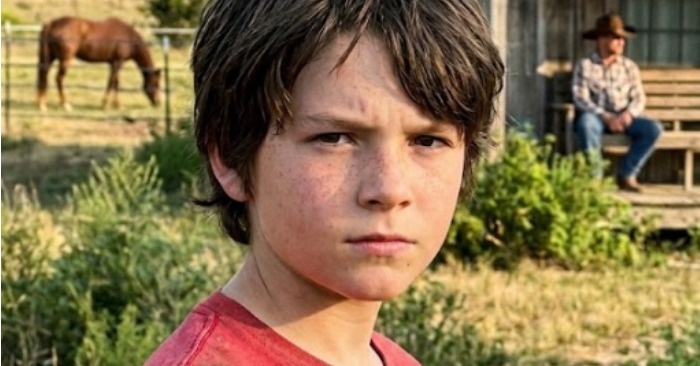
The sun was just beginning to rise behind the mountains of Oaxaca, painting the sky a pale gray, but for Miguel the day already felt heavy before it had even begun. At twelve years old, his large dark eyes no longer reflected the innocence of childhood, but a caution shaped by harsh lessons. The sound of Doña Carmela’s heavy footsteps approaching his door made his stomach twist into a familiar knot.
— Miguel! It’s already morning. The water won’t fetch itself! — the woman shouted, knocking against the wood.
Miguel jumped out of bed, slipping on his worn-out shoes that already pinched his toes. Since his mother died and his father, Alberto, married Carmela, life had become an obstacle course. His father, a good man but often absent because of construction work in the city, had no idea what happened when he wasn’t home. In front of Alberto, Carmela was sweet and caring, but the moment the door closed behind him, she turned into a merciless overseer.
The day went on as always: hauling heavy buckets from the communal well, feeding the animals, and receiving scoldings for tasks that were never good enough. But today there was a small light: his father would call. Miguel clung to that thought as he walked to school with a half-empty stomach. He planned to tell him everything. He had to know that Carmela hit him, left him without dinner, treated him like a servant.
But hope is fragile when you live in fear. When he returned from school, he found a scene that froze his blood. Carmela was speaking with a neighbor in the yard, unaware that the boy was quietly approaching.
— Alberto will call today — Carmela said with a mocking laugh —, but I won’t let him speak to the boy. Every time they talk, Alberto gets those ideas about taking him to the city. I’ll tell him he’s asleep or being punished. That boy stays here; I need someone to serve me.
Miguel stood still behind the wall. His only escape, the only voice that could save him, would now be silenced. That night, he pretended to sleep. He heard the phone ring. He heard Carmela’s sweet voice lie to his father: “Yes, my dear, Miguel is happy, already asleep, and always gets top grades.” Each lie was a stab to his heart.
In that moment, lying in the darkness, Miguel made a decision that would change his fate forever. He couldn’t wait for someone to save him; he had to save himself. He waited until Carmela was snoring. With trembling hands, he packed the little he had: a clean set of clothes, a photo of his mother, and an old silver locket.
He opened the window carefully. The cold night air hit his face, but it carried something new: freedom. He jumped into the yard and took one last look back. He didn’t know where he would go, maybe to a distant uncle he barely remembered, but he knew that any place under the stars was better than the suffocating roof above him. He slung his bag over his shoulder, wiped away a lonely tear, and began walking into the darkness of the road, unaware that fate had an even greater trial waiting for him before he could find peace.
The night was endless. Miguel walked guided by moonlight, avoiding main roads out of fear that Carmela or the police might be looking for him. The cold gnawed at his bones, and fear of coyotes or strangers kept him constantly alert. When the sun rose, exhaustion weighed on his legs like dead weight. He had walked miles, left everything he knew behind, and entered mountain communities he had never seen before.
By midday, the heat became his new tormentor. Thirst burned his throat. His lips were dry and cracked. In the distance, he spotted a tall stone wall, and behind it, the green canopy of trees that promised shade. It was an imposing hacienda, though its walls showed the wear of years. A weathered wooden sign read: “Rancho Los Nogales.”
Miguel hesitated. What if they chased him away? What if they called Carmela? But thirst was stronger than fear. With his last strength, he knocked on the wooden gate. No answer. He knocked again, and just as he was about to collapse, the gate creaked open.
Before him stood an old man, about seventy years old, tall but bent by the weight of life. His face was lined with deep wrinkles, but his eyes held a kindness that disarmed Miguel.
— What can I do for you, boy? — the old man asked in a rough voice.
— Water… please, sir. Just a little water — Miguel pleaded, his voice barely a whisper.
The old man, Don Javier, studied him carefully. He saw the dust on his clothes, the broken shoes, and the desperation no child should carry. He opened the gate wide.
— Come in, boy. No one stays thirsty here.
What began with a glass of water turned into a hot plate of food prepared by Doña Rosa, the hacienda’s cook. Miguel devoured the tortillas and beans as if they were the finest meal in the world. Don Javier sat across from him, watching in silence, with a patience that invited trust.
— A boy doesn’t walk alone through this area without a very good reason — Don Javier said gently when Miguel finished eating —. I won’t judge you, but I need to know if you’re in trouble.
Miguel, who had learned not to trust adults, looked into the old man’s eyes and felt he could finally release the weight. He told him everything: his mother’s death, Carmela’s cruelty, the broken communication with his father, the escape. At the end, he expected scolding or the police. Instead, he saw a tear run down Don Javier’s cheek.
— No one should have to live like that — the old man sighed —. My son Alejandro… he always wanted to fill this house with children. Life took him too soon.
Don Javier made him an offer: he could stay at the hacienda for a few days to recover while they tried to locate his father. In return, Miguel insisted on working. “I don’t want charity, sir, I want to earn my bread,” he said with a determination that surprised the old man.
Days turned into weeks. Miguel proved to be tireless. He had a natural gift with animals; horses that were usually nervous calmed under his touch. He repaired fences, cleaned stables, and helped Don Javier organize papers that had gathered dust for years.
The hacienda, which had been slowly fading since Don Javier’s son died, began to awaken. Miguel’s laughter echoed through the empty halls. Don Javier, who had once spent his days sitting on the porch watching time pass, rode again to show the boy the land’s boundaries. An invisible but unbreakable bond formed between the old man and the orphaned boy.
But reality always finds a way to knock on the door.
A month after his arrival, an official car drove onto the property. It was Ricardo, Don Javier’s godson and a social worker, accompanied by police. Miguel’s heart stopped. Carmela had reported him missing.
— You have to take him, Padrino — Ricardo said regretfully —. The law is the law. The stepmother has custody as long as the father doesn’t appear.
— No! — Miguel cried, clinging to Don Javier’s arm —. I’d rather live on the streets than go back to her!
Don Javier stepped between the boy and the officers, straightening himself as he had in his prime, reclaiming his authority.
— This boy doesn’t leave this house until his father is here. If you take him back to that woman, you’ll have to arrest me too. I’ve seen the marks on his back, Ricardo. You know that’s not discipline—that’s torture.
The tension was thick. Ricardo, moved by his godfather’s determination and the real fear in Miguel’s eyes, bought them time. “I’ll give you 48 hours to find the father,” he said. “But if he doesn’t appear, I can’t stop the process.”
They were the longest hours of their lives. Don Javier moved mountains, using old contacts until they finally located the construction company in Mexico City where Alberto worked.
When Alberto stepped out of a taxi at the gates of Los Nogales two days later, he looked like a man aged by worry. Miguel ran toward him but stopped a few steps away, filled with fear. Would he believe him? Would he be angry?
Alberto dropped to his knees and opened his arms.
— Forgive me, my son. Forgive me for not seeing what was right in front of me.
The embrace between father and son broke the dam of suppressed emotions. Alberto heard the truth, saw the refuge Don Javier had given his son, and swore Carmela would never come near them again. Immediately, he began divorce proceedings and filed abuse charges.
But there was a problem: Alberto had no job in the city if he wanted to stay with Miguel, and they had no home. That’s when Don Javier, with a clever smile, placed a hand on Alberto’s shoulder.
— This hacienda is too big for an old man and an energetic boy. I need a foreman, someone strong who knows how to fix things. There’s a small house near the garden that’s empty. It’s not a palace, but it’s a home.
Alberto looked at Miguel, whose shining eyes said everything.
— I accept, Don Javier — he replied. — We’ll work hard to repay your kindness.
Years passed, and Rancho Los Nogales flourished like never before. Under Alberto’s management and Miguel’s growing vision, the fields became productive again. Miguel not only regained his childhood but found an extended family. He attended school in the village, where he stood out for his intelligence, and in the afternoons learned the secrets of the land from “Grandfather” Javier.
The day came when Miguel turned eighteen. He had grown into a strong, noble young man. That afternoon, Don Javier, now walking with difficulty and leaning on a cane, asked him to go with him to an old tree where he often reflected.
— Miguel — the old man said, his voice trembling as he pulled a small velvet box from his pocket —. When my son Alejandro died, I thought the Montero family name and this hacienda would die with me. I closed my heart because it hurt too much to hope for anything from the future.
He opened the box. Inside was a gold pocket watch engraved with the family crest.
— But then you came. A frightened boy asking only for water, and you gave me an ocean of hope. You don’t carry my blood, Miguel, but you carry my spirit. You’ve cared for this land and this old man better than anyone.
Don Javier handed him the watch and a sealed envelope.
— I’ve spoken with the notary. Alberto will remain the manager, but legally, you are my heir. Los Nogales will be yours when I’m gone. I want you to go to university, study agronomy as you dreamed, and come back to make this place even greater.
Miguel, holding the watch with his throat tight with emotion, embraced the old man. There were no words enough to thank him, so he did the only thing he knew: he promised with his eyes to honor that legacy every day of his life.
— Thank you, Grandfather — Miguel whispered. It was the first time he had called him that aloud.
Don Javier smiled, a full and peaceful smile.
Miguel looked toward the horizon, where the sun painted the fields gold. He remembered the dark night when he had escaped through the window, feeling like the loneliest being in the universe. Now he understood that escape had not been an ending, but the painful and necessary beginning of his true destiny.
Life had taught him that family is not always the blood that runs through your veins, but the hands that lift you when you fall, the door that opens when you are thirsty, and the heart that chooses you to share its legacy. Miguel held the watch close to his chest, ready to write the next chapter of Los Nogales’ story.