On a cold winter evening, I bought shawarma for a homeless man and his dog. At that moment, it seemed like a simple act of kindness. But when he slipped me a note pointing to a past I had long forgotten, I knew: This encounter was far from ordinary.
I worked in a sports store at a mall downtown. After 17 years of marriage, two teenagers, and countless late shifts, I thought nothing could surprise me anymore. But life has a strange way of proving you wrong.
That day had been particularly exhausting. Customers wanted to return items they’d obviously already worn after the holidays. Plus, one of the cash registers kept jamming, and my daughter Amy had texted me about failing yet another math test. We seriously needed to consider getting her a tutor.
These thoughts swirled in my mind as my shift finally ended. As if that weren’t enough, the temperature outside had dropped so much that the cold crept into my bones. The thermometer in front of the store showed minus 3 degrees Celsius.
The wind howled between the buildings, swirling loose pieces of paper across the sidewalk as I stepped outside. I pulled my coat tighter around me and only thought about the warm bath I’d take when I got home.
On my way to the bus stop, I passed the shawarma stand, which had been there almost as long as I had worked at the store. It was located between a closed flower shop and a dimly lit little kiosk.
Steam rose from the hot metal plate. The scent of roasted meat and spices was so tempting that I almost stopped. But I didn’t particularly like the vendor. He was a burly man with deep, permanent frown lines on his face.
The food was good, and you got your shawarma in a matter of seconds, but today I really didn’t feel like dealing with bad moods.
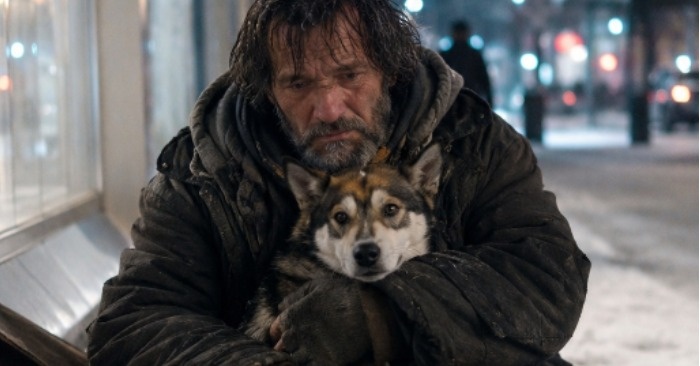
STILL, I STOPPED WHEN I SAW A HOMELESS MAN APPROACHING THE STAND WITH HIS DOG. THE MAN WAS IN HIS MID-FIFTIES, SHIVERING FROM THE COLD AND STARING HUNGRILY AT THE ROTATING MEAT.
He was wearing only a thin coat, and the poor dog had barely any fur. The sight broke my heart.
“Are you ordering something or just standing here?” the vendor snapped at him.
I saw the homeless man gather all his courage. “Please, sir. Just some hot water?” he asked with his shoulders slumped.
Sadly, I already knew what the vendor would say, even before he spoke. “GET LOST! This is not a charity!” he barked.
The dog pressed closer to its owner, and I watched the man’s shoulders sag. At that moment, my grandmother’s face suddenly appeared in my mind.
She had raised me with stories of her tough childhood and often told me how a single kind act once saved her family from starvation. I’d never forgotten that lesson. Even if I couldn’t always help, her words came to me in such moments:
“Kindness costs nothing, but it can change everything.”
BEFORE I EVEN FULLY THOUGHT ABOUT IT, I HEARD MYSELF SAY: “TWO COFFEES AND TWO SHAWARMAS.”
The vendor nodded and worked quickly. “Eighteen dollars,” he said curtly as he placed the order on the counter.
I handed him the money, grabbed the bag and drink carrier, and hurried to catch up with the homeless man.
When I handed him the food, his hands were trembling.
“God bless you, child,” he whispered.
I nodded awkwardly, eager to hurry home and escape the cold. But his rough voice stopped me.
“Wait.”
I turned around and saw him pull out a pen and a piece of paper. He quickly scribbled something on it and handed me the note.
“READ IT AT HOME,” HE SAID WITH A STRANGE SMILE.
I nodded and slipped the note into my coat pocket. My mind had already wandered elsewhere, wondering if I’d get a seat on the bus and what I should make for dinner.
—
At home, life continued as usual that evening. My son Derek needed help with his science project. Amy was complaining about her math teacher. My husband Tom was talking about a new client at his firm.
The note remained forgotten in my coat pocket until the next evening when I was gathering laundry.
I unfolded the crumpled paper and read the message:
“Thank you for saving my life. You don’t know it, but you saved it once before.”
Beneath that were a date from three years ago and the name “Lucy’s Café.”
THE CLOTH I WAS HOLDING ALMOST DROPPED. LUCY’S HAD BEEN MY REGULAR CAFE FOR LUNCH BEFORE IT CLOSED.
And suddenly, I remembered that day perfectly. There had been a storm, and many people had sought refuge in the café to escape the rain.
A man had stumbled in. His clothes were soaked, and his eyes held a desperation that cried out for more than just food. He needed something to hold onto.
No one had looked at him except me. The waitress had almost sent him away, but just like the other day, I had heard my grandmother’s voice in my head.
So, I bought him a coffee and a croissant.
I wished him a good day and gave him my warmest smile. To me, it hadn’t been anything special… or so I thought.
It was the same man. And my heart broke again. His life had clearly not gotten better, and yet, he had remembered my small gesture. But did it really take just buying food every few years?
That night, I couldn’t sleep because that thought wouldn’t leave my mind.
THE NEXT DAY, I LEFT WORK EARLY.
Luckily, I found him near the shawarma stand. He was slumped in a corner, holding his dog tightly in his arms. The sweet little guy wagged his tail when he saw me.
“Hello,” I said with a cautious smile. “I read the note. I can hardly believe you remembered back then.”
The man looked up at me in surprise and gave me a brittle smile.
“You’re a bright spot in a hard world, child,” he said. “And you’ve saved me twice now.”
“No,” I said, shaking my head. “It was just some food and a bit of humanity. I want to do more. Can I really help you?”
“Why would you do that?”
“Because every person deserves a second chance. A real one.”
HE NODDED FINALLY, AND I ASKED HIM TO COME WITH ME.
There was so much to do to help him get back on his feet, and since my husband was a lawyer, I knew there was something we could do for him. But first, I wanted to get to know him. So I invited him to a café, properly introduced myself, and found out that his name was Victor.
Over two cups of coffee, a shared slice of berry cake, and a little dog treat for Lucky, Victor told me how he had lost everything. He had once been a truck driver, with a wife and a daughter.
On a rainy night, a car had swerved into his lane. The accident shattered his leg and left him with overwhelming medical bills. When he couldn’t find new work, his wife took their daughter and left him.
Despite his injuries, his company refused to pay him disability benefits. And at some point, depression consumed him completely.
“That day at Lucy’s,” he confessed, clutching his coffee cup, “I wanted to end my life. But you smiled at me. You treated me like a human being. That gave me one more day. Then another. And another. Eventually, I found Lucky, who had been abandoned, and I kept going. I didn’t feel so alone anymore.”
Tears ran down his cheeks.
“And now you’re here again,” he said quietly. “Just when this weather almost made me think about giving up Lucky, so at least he could have a home.”
I shook my head, tears rising in my own eyes.
“No. You don’t have to do that. I’m here now. Lucky isn’t going anywhere without you.”
—
That very evening, I contacted a local home and found a place for Victor and his dog.
I also started a fundraising campaign for new clothes and essentials. My children helped create the posts for social media. Additionally, one of Tom’s colleagues, who specialized in disability cases, was immediately ready to take on Victor’s case pro bono.
Once that was settled, we helped Victor apply for new ID documents and important papers that had been stolen while he was sleeping on a park bench.
It took another month before we found a proper room to rent near the home. With a permanent address, he got a job at a warehouse in a factory. His supervisor even allowed Lucky to come along, and the dog quickly became the unofficial mascot of the early shift.
On my birthday the following year, the doorbell rang. Victor was standing there, holding a chocolate cake from the bakery in the neighborhood.
HE WAS CLEAN-SHAVEN, NEATLY DRESSED, AND HIS SMILE RADIATED A CONFIDENCE I HAD NEVER SEEN IN HIM BEFORE. EVEN LUCKY WORE A NEW RED COLLAR.
His eyes sparkled with gratitude as he said, “You’ve saved my life three times now—at the café, at the shawarma stand, and with everything you did afterward. I’ll never forget that. I wanted to bring you this cake, but honestly, it’s far too little for the heroine who was born that day.”
I smiled and refused to cry again, then invited him in.
As my family ate cake with our friend and chatted, I thought about how close I came to missing it that cold evening. Too busy with my own worries to notice the pain of another person.
How many other Victors were out there, just waiting for someone to truly see them?
That’s why I often repeated my grandmother’s words to Amy and Derek, reminding them always to be kind and to seize every opportunity to make the world a little bit less harsh.
You never know if that one gesture will be the lifeline for someone.