Roberto Cavalcante clutched the letter like a lifeline, yet the crumpled paper could not bear the weight of the empire closing in on him. Outside his office window, the city gleamed with its usual arrogance: towering buildings, endless traffic, hurried men pretending to have everything under control. But at sixty-five, Roberto breathed like someone who had been running without direction. For the first time in decades, he had no answers.
The letter had arrived without a sender. Only one name he had not seen in nine years: Marlene. Beneath it, an address lost somewhere in Pernambuco, a point on the map where even GPS seemed uncertain. Roberto had sworn his entire life was built on never returning there—never to her, never to that day when he had shouted, humiliated, thrown her out, and slammed the door as if closing a chapter. But the letter held no accusations. It offered coordinates. As if the past refused to stay buried.
— Are you sure, Mr. Cavalcante? — asked Carlos, his trusted driver, as Roberto already stared at the road.
— This time, I’m going alone — he replied with a firmness that sounded more like fear than decision.
He rented a modest van, traded his suit for a plain shirt, and drove for hours along a dusty road. With every kilometer, the air shifted: less concrete, more earth; less noise, more silence. Roberto rehearsed countless sentences, carefully crafted apologies, explanations to preserve his pride. But what he could not practice was the feeling that something waited for him at the end—something that could break him in two.
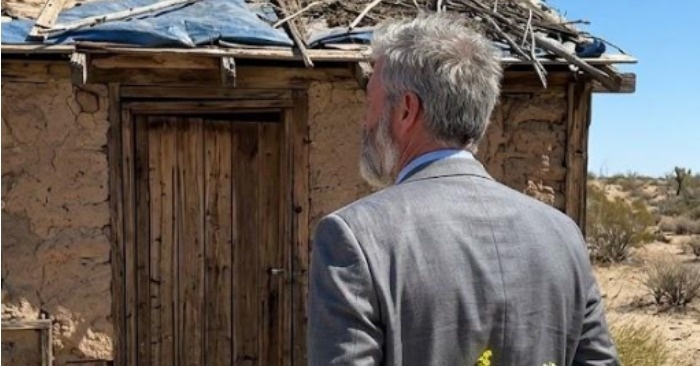
When the GPS announced the destination, Roberto slammed the brakes. He sat motionless, hands tense on the wheel. In front of him was no house… but an open wound: peeling clay walls, a collapsed roof, rotting wood—the place his money had ignored all his life. And yet, here he was.
He stepped out, holding a bouquet he had impulsively bought from a roadside stand. It felt absurd. Flowers? After nine years? The Sertão wind tore a petal away and threw it into the dust, like an answer. Roberto swallowed and knocked on the door.
— Marlene…? — he called, with a voice that didn’t seem like his own.
The door creaked open slowly. And there she was.
It was Marlene… and yet not. Her once blonde, flawless hair was now gray, tied into a simple bun. Her hands were marked, rough, as if they had learned to fight life. But what struck him most were her eyes: still green, but without shine; a cold calm sharper than any blow.
— What are you doing here, Roberto? — she said, without fully opening the door.
He felt the words stick in his throat. For nine years, he had built excuses, and suddenly none of them were enough.
— I had to see you… We need to talk.
— After everything you did? — Marlene crossed her arms —. After nine years?
Roberto raised the flowers like a clumsy child offering a cheap apology gift.
— I… didn’t come to offend you. I came because… because I’m losing everything.
Marlene looked at the bouquet as if it were a bad joke.
— Did you come to buy my conscience? To try the same as always?
At that moment, an older man appeared on the path carrying a bucket of water. He greeted Marlene warmly and eyed Roberto with suspicion.
— Everything alright, Dona Marlene?
— Everything’s fine, Seu Antônio — she replied in a soft tone Roberto hadn’t heard in years —. Just a visit.
When the neighbor walked away, Marlene sighed and reluctantly opened the door.
— Come in. No rumors.
Inside was another blow. One room served as both living room and kitchen. An old fan turned slowly, as if tired. Minimal furniture, some made of recycled wood. No luxury. No comfort. And yet… there was order. There was dignity.
— Sit down — Marlene said, pointing to a plastic chair.
Roberto sat like someone unsure where to place his own body. He looked around, trying to understand how a woman who once lived in mansions now lived here.
— Marlene… how did you end up here?
She stared at him.
— Do you really want to know? Or do you just want to feel less guilty?
Roberto opened his mouth, but she didn’t give him time.
— After you threw me out, I tried to start over. I sold my jewelry. Rented a small apartment. Looked for work. And do you know what I found? Closed doors. People who “already had someone.” Silence. Rumors.
Roberto frowned.
— I…
— Yes, you — she cut him off with painful precision —. You said I was unstable. That I wanted to steal secrets. That I was dangerous. It wasn’t enough to throw me out of your house. You wanted to erase my name everywhere.
The air grew heavy. Roberto felt his throat burn. He had spent years justifying himself: “the argument,” “the betrayal,” “my pride.” But here, in this simple house, the truth sounded different. It sounded dirty.
Marlene continued, staring out the window as if telling someone else’s story.
— When the money ran out, I was evicted. I spent months in a women’s shelter. Months, Roberto. With fear. With hunger. With cold. Then I got a job as a cleaner in a hospital. What I earned barely paid for a room in a hostel.
Roberto clenched his fists.
— I… didn’t know.
— You didn’t know because you didn’t want to know — she said calmly —. Later, I found Dona Socorro. Remember her? The employee who worked in your house. She told me about this place, my grandmother’s house. It was still in my name. I saved for two years just to buy the ticket. I came here and found only ruins: no electricity, no water… but it was mine. The only thing you couldn’t take from me.
Roberto felt the bouquet weigh heavily in his hands.
— And you never… thought about looking for me?
Marlene let out a bitter laugh.
— Look for you? You changed your phone number, your address, left the country for a while. And even if you hadn’t… why? You made it clear you didn’t want to see me. You slammed that door.
Roberto lowered his head. The memory of their last fight flooded back: him shouting she was “an obstacle,” “an ornament,” “dead weight.” He remembered humiliating her in front of employees, changing the locks, sending lawyers. He felt sick.
— I came because the company… our company… is on the brink of collapse — he finally admitted —. It’s about to go bankrupt. And I don’t understand how it happened.
Marlene tilted her head.
— And what does that have to do with me?
— You were the mind behind the best projects. Without you… I only made money. But now, not even that.
Marlene stood up and took the bouquet from his hands. Roberto felt a flicker of hope… until she dropped it on the floor.
— I learned something here, Roberto — she said calmly —. Flowers don’t fill a stomach. Pretty words don’t pay bills. And promises don’t heal wounds.
He swallowed.
— So… you won’t help me?
— I didn’t say that. I said none of this impresses me. But… maybe we can talk business. With rules.
Roberto looked up like a man seeing water in the desert.
— Any rule.
— Everything in writing. Everything clear. I want numbers, contracts, everything. And understand this: I’m not doing it for you. I’m doing it for the families who depend on that company.
Roberto nodded. For hours, he explained the crisis: lost contracts, an international competitor ahead with insider information, fleeing investors, desperate employees. Marlene listened without interruption, taking notes with the same seriousness he remembered… only now her gaze was sharper.
— I always suspected Henrique — she said at last.
— Henrique? My vice president…
— He could never stand my influence. But even if you find the traitor, it won’t save you. What’s destroying you is something else: you stopped innovating. You became conservative. Your company lives off past glory.
Roberto felt a stab to his pride but couldn’t deny it.
Marlene went to a cabinet, took out an old wooden box, and opened it like a secret.
— When you threw me out, I took documents — she said.
Roberto tensed.
— What documents?
— Projects we built together. The ones you abandoned when you focused only on quick profit. — She pulled out a yellowed folder with diagrams and calculations —. Remember my sustainability proposal? You laughed. You said I was a dreamer.
Roberto stared at the papers. He recognized her handwriting in the margins. And his heart sank as he realized: this was a complete strategy to transform the company into a leader in sustainable technology.
— This… is brilliant — he murmured.
— It was ten years ago. Now it’s a desperate race to catch up on what we missed. But it can still work… if you’re willing to change your philosophy. If you accept that money isn’t everything.
Roberto looked around at the modest house, the simplicity that needed no permission to exist. And for the first time, he understood something he had never allowed himself to see: luxury can also be a cage.
Over the following days, Roberto rented a house nearby and began commuting. They worked side by side with a strange rhythm: mornings of numbers and strategy; afternoons of people. Because Marlene didn’t just talk about projects. She spoke of children without schools, elderly without doctors, families without water. At first, Roberto listened as if hearing distant news… until he saw it.
One afternoon, Dona Francisca arrived, an elderly woman with a warm smile and a sharp tongue. She looked Roberto up and down.
— So you’re the one who threw our Marlene away like an old dog?
Roberto felt the blow without defense.
— Ma’am…
— No. Listen. — Dona Francisca pointed her finger —. She came here broken. Hungry. Ashamed. And still… she never spoke badly of you. Do you understand that? You chose revenge. She chose survival… and helping others.
Roberto looked at Marlene, surprised.
— Is that true?
She lowered her gaze.
— I didn’t want my life defined by hatred for you.
Dona Francisca ended with a sentence that drove like a nail into Roberto’s heart: “Some people only recognize another’s value when they need them.”
That night, Roberto couldn’t sleep. For the first time in years, silence revealed his own loneliness. And the next day, he did something he would once have called a “waste of time”: he helped repair a roof, carried water with Seu Antônio, bought school supplies for the children Marlene taught. Not for show. Somehow, that simple exhaustion filled a void money had never touched.
When Marlene eventually discovered the leak came from Patrícia—a secretary being blackmailed to cover her son’s expensive treatment—Roberto felt shame at how little he knew about his employees’ lives.
— To you, she was just a number — Marlene said, not cruelly, just truthfully.
Roberto spoke with Patrícia and offered unconditional help. She cried. And the disinformation plan worked: the competitor began to stumble while they implemented the sustainable project and even hired local talent—people who had never been given a chance.
The company began to breathe again. And Roberto… did too.
But the transformation wasn’t a straight path. One day, Henrique appeared with evidence: Patrícia wasn’t a victim. She had sold information out of greed. And she was planning one final blow—stealing the entire project and delivering it to the competitor.
Roberto felt the same coldness as with the first letter. Once again, on the edge of the abyss.
— Kindness isn’t naivety — Marlene said, looking him straight in the eyes —. You can help without destroying yourself.
That night, they adjusted the plan: altered files with subtle errors, technical traps only an expert would detect too late. Patrícia delivered the false material, took the money… and weeks later, the competitor collapsed under its own deception. The truth came out. The company wasn’t just saved—it grew, gaining a reputation as an ethical brand.
Amid the storm came the conversation Roberto would never forget. One night, under a sky fuller than any skyscraper, Marlene spoke softly, as if the earth itself were listening.
— When you threw me out… I found out I was pregnant.
Roberto felt the world shatter.
— What…?
— I lost the baby three weeks later. Stress. Hunger. Loneliness.
Roberto cried like never before. Not tears of business failure, but of delayed humanity.
— I’m sorry… sorry for everything.
Marlene held his face with both hands.
— If you live in the past, you won’t be able to be better now. I don’t forgive you “all at once.” I try. Every day. Because forgiveness is also a way of saving yourself.
From that moment on, it wasn’t Roberto’s words that changed, but his actions. He rejected a multimillion offer from investors who wanted to buy the company and “optimize” the project without social responsibility.
— For the first time, I have something more valuable than money — he said —: a purpose.
Marlene smiled—a real smile, like sunrise.
They signed a contract: six months. Not as a couple. As partners and friends. Roberto sold his mansion, moved nearby, learned to cook, to wait for rain, and to accept that life isn’t always measured by speed. With the new income, he supported Marlene’s dream of a community education and health center: classrooms, library, clinic, basic pharmacy. People worked together as if building more than walls.
On the eve of the six-month deadline, there was a simple celebration. No luxury lights, no formal music. Just laughter, shared food, children running, adults proud of what had once been dust.
— Tomorrow we decide — Marlene said with gentle seriousness —. Don’t get your hopes too high.
— I’m not — Roberto replied —. I’m grateful. I learned that from you.
The next morning, they sat in the same yard where he had arrived desperate, with useless flowers and broken pride. Roberto took a deep breath.
— If you tell me it won’t work… it will hurt. But I’ll stay. This work no longer depends on you to have meaning. I found something here too.
Marlene looked at him for a long time, as if reviewing every version of the man he had been.
— My answer… is yes — she finally said —. Yes to truly trying. But as equals. No cages. No contempt. No repeating the same mistakes.
Roberto didn’t respond with grand promises. He simply took her hand and held it with a respect he had never known before.
Years later, when they remarried in the same community center, there were no luxuries—but there was something missing from their first wedding: peace. Roberto finally understood that wealth wasn’t what he kept in bank accounts, but what he built with his hands and his conscience. Marlene, who had rebuilt her life from ruins, understood that love doesn’t always return as it once was… sometimes it comes back as something more mature, more humble, more real.
And as they walked hand in hand along the dusty road at dusk, families moving in and out of the center, Roberto whispered:
— I almost lost everything to learn what truly matters.
Marlene squeezed his hand.
— Sometimes life takes away what you have in excess… so you can see what you lack.
Under the Sertão stars, where silence was not loneliness but peace, they both knew their story wasn’t perfect. It was better: it was real.