When Callie’s husband humiliates her in front of the whole family, years of silent sacrifices boil over in a single moment. But what begins as heartbreak slowly becomes something else: a reckoning, a mirror, and a chance to reclaim herself. Sometimes you have to break before you remember your own worth.
Sometimes I wonder what people see when they look at me now.
Maybe they see a tired woman with dark circles under her eyes and frizzy hair, wearing pharmacy scrubs that carry the faint smell of disinfectant.
Maybe they see someone who has given up a little—someone who stopped trying.
What they don’t see are the 5 a.m. wake-ups, the three children I dress, feed, and send off to school before most people have even opened their eyes. They don’t see me stocking shelves, calling insurance companies, juggling prescriptions while silently praying I remembered to take the chicken out of the freezer in time.
They don’t see that I’m still there—every single day—even when no one thanks me for it.
But he sees it. He sees all of it.
And he still makes fun of it.
When I married Ryan twelve years ago, life felt like a promise full of possibilities. Ryan was ambitious, funny, attentive—the kind of man who brought me flowers for no reason, cooked my favorite meals just to see me smile, and stayed up late talking about our future as if it were something sacred.
We built a life together. A real life in a house with stained carpet and mismatched mugs, a refrigerator covered in children’s handprint art, and three wild, beautiful kids.
I work as a pharmacist. It’s a profession I’m proud of, even though it drains me. Hours on my feet, twenty tasks at once, customers who think I personally set the price of medication.
Some days I barely sit down. But it’s a stable job—one that reliably keeps my family afloat.
And for a while, Ryan understood that.
Almost a year ago he lost his job. It was part of a wave of layoffs, sudden and without warning. We told ourselves it was temporary. That he would take a moment to breathe, to regroup. That everything would work out again.
At first I helped him. I stayed awake after long shifts, editing his résumé, scrolling through job listings while our youngest fell asleep in my arms. I printed advertisements, highlighted sections, even wrote emails on his behalf.
I wanted to believe it was just a phase… just a bump in the road that we would smooth out together.
“Hey,” I said one evening, sliding the laptop across the table to him. “Here’s a position that’s fully remote. Good pay, exactly in your field.”
“Yeah, I saw it,” he replied without looking up from his phone. “They want too much experience. Besides, I don’t want to work from home forever.”
“You said that last week too,” I said carefully. “It’s only three months.”
“Nobody hires right before the holidays, Callie. You know how it works,” he shrugged.
And the excuses only multiplied.
“That job is beneath me.”
“I am looking, Callie. Stop nagging.”
“I’ll apply tomorrow.”
But that tomorrow never came.
While he waited for something “perfect,” I took on more shifts. I paid bills, packed lunches, sat through soccer games, folded laundry at midnight, and went to work before the sun came up.
Some mornings I caught my reflection in the hallway mirror—dull skin, hair tied in the same bun for two days. Not because I didn’t care… but because I had nothing left to give.
And instead of gratitude, I got sarcasm.
“You used to wear real clothes, Callie,” he said once while I ironed my lavender scrubs. “Do you even remember what actual dresses look like?”
Another time he leaned in the doorway while I was changing.
“Skipped the gym again?” he smirked. “You used to have so much more energy… and a perfect waist.”
He laughed and pinched my side as if it were a joke.
But it wasn’t.
What hurt most wasn’t that he noticed the change—it was that he seemed to have forgotten why it had happened. He no longer remembered the woman who used to slip little notes into his lunchbox or massage his shoulders when he worked late.
I kept telling myself Ryan was just lost. That he didn’t really mean those words.
But even patience has a pulse. And mine was fading.
The moment something inside me finally tipped came during his mother’s birthday dinner. I had just finished a late shift and drove there directly without changing—still in my uniform. My back ached. My feet throbbed.
My head buzzed from the long day—and yet I was there.
Because I am always there.
The house smelled of roasted lamb and lemon cake. Candles flickered along the long dining table, laughter filled the room, mixed with the pounding footsteps of children running down the hallway.
I handed my mother-in-law a small gift and kissed her on the cheek. She smiled, thanked me, and immediately turned to greet the next person.
No one noticed that my name badge was still pinned to my chest.
Ryan was already seated at the table with a drink in his hand, talking as if the past year had been kind to him. His shoulders were relaxed, his laughter too easy. I sat beside him and tried to disappear into the noise of the room.
I brushed crumbs from my lap and smiled whenever someone glanced my way.
For a while it worked. Plates were passed around. Polite laughter circled the table. I pretended we were truly this happy family.
Then Ryan leaned back in his chair and said, just loudly enough for everyone to hear:
“Good grief, Callie. Couldn’t you at least brush your hair? You look like you just got out of bed.”
A few people shifted awkwardly in their chairs. My hand tightened around my fork.
“I came straight from work,” I said simply. “I didn’t have time to go home and change.”
Ryan laughed loudly, and suddenly every pair of eyes was on us.
“You’ve been tired a lot lately, huh?” he said. “Remember Anna from my old office? Two kids, full-time job—and she still looked amazing every single day. Hair done, makeup, everything. Fit and slim. She never let herself go, Callie.”
His voice sounded casual, amused, as if he were offering helpful advice.
“Not like… this,” he added, gesturing toward me.
The air in the room grew heavy. My cheeks burned.
“Good for Anna,” I replied quietly. “I’m sure she has help.”
I reached for my water glass, trying to steady my breathing.
“I’m just saying,” Ryan shrugged. “Some women still take care of themselves. Even after kids.”
It wasn’t the first time he had said something like that. But it was the first time he had said it in front of everyone—people I had spent years trying to impress.
Something inside me hardened—not a scream, not an explosion. Just a quiet, solid enough.
I slowly stood up, my chair scraping against the floor.
“I’d also like to make a toast,” I said, lifting my wine glass.
Ryan grinned. He thought I was going to let him get away with it.
I wasn’t.
“To my husband,” I began. “Ryan. The man who thinks it’s funny to humiliate his wife in front of the family—even though she pays the bills, raises the children, and holds our home together while he has been ‘looking for the right job’ for almost a year.”
Someone at the far end of the table inhaled sharply. A fork clattered against a plate. But no one said a word.
“To the man who wakes up at noon, hasn’t helped with homework in months, yet still finds time to compare me to women who have never had to carry what I carry.”
I let my gaze travel slowly around the table. Patty, my mother-in-law, stared at her napkin. Mel, Ryan’s cousin, looked at me with wide, sad eyes. Ryan’s face had turned red, his jaw tight.
But I wasn’t finished.
I reached for my wedding ring and slowly slipped it off my finger. Then I placed it directly on the table in front of him.
“You want me to make more effort, Ryan?” I asked calmly. “Then start by lifting a finger in this house—rather than just protecting your ego.”
Then I turned, straightened my shoulders, and walked out.
I didn’t even call the kids to come with me.
That night I sat quietly on the couch. I didn’t cry. I didn’t scream. I simply sat there, still in my scrubs, letting the silence wrap around me like a heavy blanket. It didn’t feel lonely.
It felt honest.
Later I heard Ryan come home with the children, but he didn’t enter our bedroom. Not long afterward I heard him leave again.
The next morning I woke up to missed calls. And messages—apologies, one after another.
I didn’t respond. I had a rare day off, and I wanted to spend it with my children, not entertaining my ridiculous husband.
That evening, while my roast chicken cooked in the oven, there was a knock at the door. When I opened it, Ryan stood there—somehow smaller, pale, his eyes red.
“Can I come in?” he asked quietly.
I stepped aside.
My husband walked inside and sat on the edge of the couch, rubbing his ring between his fingers.
“I was cruel, Callie,” he said. “I wasn’t a husband. I wasn’t even a decent person.”
I waited. He needed to speak before I did.
“You’ve been carrying everything,” he continued softly. “You’ve carried everything for months… and because that made me feel small, I made you feel small. I don’t know who I’ve been lately, Cal. But it wasn’t fair to take it out on you.”
He paused, pressing his hand to his forehead.
“I don’t expect you to forgive me right away. But I will change. I called three companies this morning. I’m done hiding behind excuses. I will do better, Cal. And I’ll take any job that will have me.”
I stayed silent—long enough for the weight of that silence to reach him.
Part of me wanted to believe him. Another part—the hurt, exhausted part—was tired of words.
“I’m not asking you to be perfect,” I said calmly. “I’m asking you to be real. To be consistent. To be better.”
“I will,” he nodded. “I will, Callie. For the kids and for you.”
“No, Ryan,” I corrected. “Do it for yourself. Start there.”
It didn’t change overnight.
But it did change.
Ryan gave me my wedding ring back. He didn’t ask me to wear it right away. One day he simply placed it in my palm.
He began getting up when I got up, rubbing the sleep from his eyes without complaining. He made breakfast while the kids argued over toys. He drove them to school, folded laundry, and listened to podcasts while doing it.
“I never thought I’d like podcasts,” he said once. “But they keep my brain awake somehow.”
One evening I came home to find him fixing the dripping faucet that had annoyed us for weeks. He kissed me goodnight without expectation, without calculation.
It wasn’t grand. There were no dramatic gestures.
But it was real.
Three months later he found a steady job. Not his dream job—but one that kept him busy and gave him back a sense of pride.
He came home tired, his hands stained with ink and small scratches, smiling in that quiet way I remembered from years ago—as if something inside him had finally clicked back into place.
One evening we were washing dishes together while the kids slept. The clatter of plates felt familiar, almost comforting. Steam rose from the sink. My hands in the water, his drying beside me. I looked over at him and asked the question I had carried far too long.
“Ryan… why did you mention Anna that night?”
He froze briefly, the towel still in his hand, then slowly looked at me.
“There was nothing between us, Callie. I swear,” he said. “I didn’t say her name because I missed her. I said it because she was… an easy comparison. And I wanted to hurt you because you kept reminding me of reality.”
His voice cracked slightly.
“I needed someone to throw my frustration at because I felt small. And I chose the person who was always there—you. Because deep down I knew you were doing everything, and I hated myself for it.”
I nodded slowly as the water cooled around my fingers.
“I really thought… maybe you wished I were more like her,” I said quietly. “So polished. So effortless.”
“No,” he said firmly. “I was ashamed. And I hid behind cruelty. I didn’t want someone like her. I just wanted to feel like a man again, and I thought tearing you down would build me up.”
His hand rested gently on my waist as he leaned closer.
“I was wrong,” he said simply.
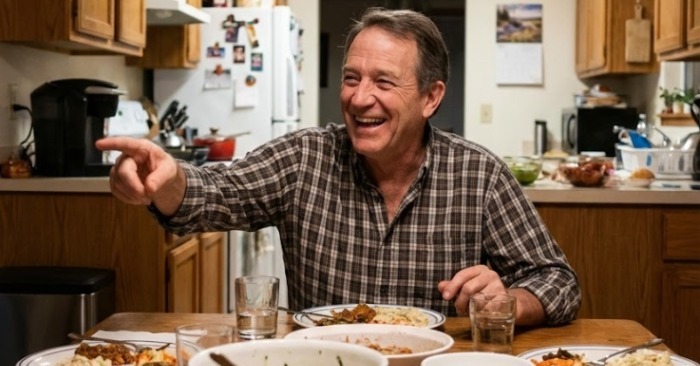
Later we sat at the kitchen table, eating leftover chocolate cake, slowly finding our places again in each other’s lives.
“Thank you,” he whispered. “For not letting me become someone I wouldn’t have been able to come back from.”
And for the first time in a long time, it felt like we were finally looking forward again.
Together.