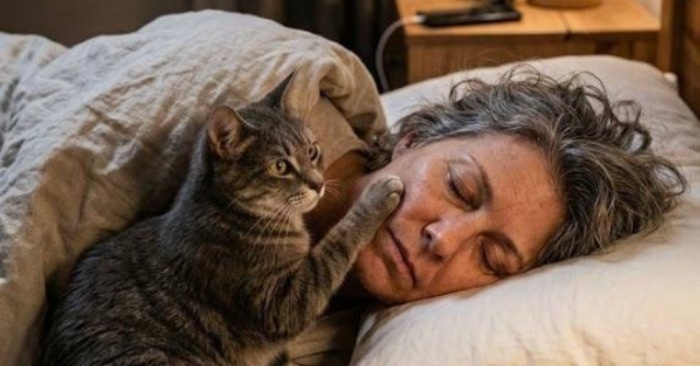
I’m a veterinarian, and I often get calls at night. People are convinced that having a diploma means you must be able to solve everything—from a dog’s sneeze to saving its life. But Anna called during the day. And there was such exhaustion in her voice, as if she hadn’t truly slept for months.
— “Hello, is this the clinic? My name is Anna. I have an appointment with you. I have a problem with my cat… she won’t let me sleep.”
The phrase “the cat won’t let me sleep” can mean many things. But there was no irritation in her tone—only real concern.
Anna arrived neatly dressed, a bit tense. About fifty-five years old, with a strict haircut, coat matching her boots. She held the carrier carefully, as if it contained porcelain.
— “This is Luna,” she said. “A beautiful name, my husband chose it. But at night, she’s not Luna—she’s an alarm clock with claws.”
From the carrier, large eyes looked at me. A sturdy gray cat with thick fur and a calm gaze. Not a trace of aggression.
— “What exactly happens?” I asked.
Anna took a deep breath.
— “SHE WAKES ME UP EVERY NIGHT. ALWAYS AROUND THREE OR FOUR IN THE MORNING. FIRST, SHE GENTLY TAPS MY FACE WITH HER PAW. IF I DON’T REACT, SHE GETS MORE INSISTENT. SHE CAN EVEN BITE MY HAND. SHE PULLS THE BLANKET OFF ME. ONLY WHEN I GET UP AND GO TO THE LIVING ROOM AND LIE ON THE COUCH DOES SHE CALM DOWN. AND AS SOON AS I’M GONE, SHE LIES DOWN ON MY PILLOW AND SLEEPS UNTIL MORNING.”
— “How long has this been going on?”
— “About three months. At first, I thought her personality had changed. Then I thought I was imagining things. The therapist said it was insomnia due to stress. He gave me sedatives. But it didn’t get better.”
Luna sat quietly beside her owner, not taking her eyes off her. I examined the cat. Heart regular, breathing calm, weight normal. A completely healthy animal.
And in that moment, with an uneasy feeling, I realized that psychologically there was nothing wrong with the cat—and that something far more disturbing was going on 😢🫣
— “Anna,” I asked, “how do you feel when she wakes you?”
She thought for a moment.
— “Bad. My heart races. My mouth is dry. Sometimes I feel like I can’t breathe. I think my blood pressure is going crazy. I take a tablet under my tongue and go into the living room. After a while, it gets better there.”
— “HAS ANYONE EVER TOLD YOU THAT YOU SNORE?”
She looked embarrassed.
— “A neighbor once said I suddenly go quiet at night and then gasp for air.”
I looked at the cat. She didn’t look away from Anna.
— “It seems Luna isn’t waking you because she’s difficult,” I said. “She may be reacting to what’s happening to you in your sleep. Animals can sense changes in breathing or irregular heartbeats. For them, that’s an alarm signal.”
Anna looked at me as if I had said something unexpected.
— “Are you saying she’s saving me?”
— “I can’t prove it,” I replied. “But I’m sure the problem isn’t with the cat. You should get examined. Blood work, sugar levels, your heart—maybe also your breathing during sleep. Start with that.”
SHE WAS SILENT FOR A LONG TIME, THEN NODDED.
A week later, Anna called again. The deep exhaustion was gone from her voice.
— “I did the tests,” she said. “My blood sugar is elevated. And the doctor sent me to a cardiologist. They found heart problems. Also, I stop breathing at night. I’ve been referred for further tests. The doctor says it’s serious.”
She paused, then added quietly:
— “If Luna hadn’t woken me up… I would have kept blaming everything on stress.”
Now Anna is undergoing treatment. She’s receiving medication and sleep therapy. She’s already sleeping better. Luna still comes to her at night, but now she simply lies beside her and purrs softly.