Roberto Mendoza walked through the dusty streets of Guadalajara as if every step weighed twice as much. He was forty-two years old, with strong hands like a mechanic and eyes that no longer knew how to find rest. Eight months earlier, his wife María had died in a car accident, and since then the house had been filled with a silence no one dared to break. He was alone with four children: Sofía, fourteen; the twins Carlos and Diego, eleven; and Valentina, six, who still searched for her mother in corners, as if love might be hiding behind a door.
The tragedy did not come alone. Three months after the funeral, the workshop where Roberto worked closed down. “No work,” they told him at the next garage, and the next. He wandered through repair shops, factories, construction sites, offering his hands and his determination, but the country seemed pressed under the same weight. The few savings he had went to the burial, to medicine, and to those days when he couldn’t get out of bed because grief had defeated his body. When he finally stood up again, there was nothing left to sell except the little they had: a shaky table, a few chairs, an old television, and María’s 2005 Tsuru—the car that still smelled of her perfume when Roberto closed his eyes and breathed, as if that scent were a form of survival.
That morning, he received an eviction notice: three months of unpaid rent. Don Esteban, the landlord, had waited as long as he could, but he had bills too. “I’m sorry, Roberto. You have until Friday,” he said. Four days. Four chances to save a home that was already falling apart.
When he entered the house, the smell of fried beans greeted him. Sofía stood at the stove with the seriousness of an adult, though she was still a child. Her brown eyes, María’s eyes, looked at Roberto before he said a word. “How was your day, Dad?” she asked. He wanted to lie, but he could only smile with a quiet sadness—the kind you learn when you don’t want your children to be afraid.
Carlos lifted his head from a notebook; Diego did the same, restless, as if the world felt too small. Valentina ran to Roberto and hugged him with a strength that didn’t seem to fit in such a small body. “Did you bring me something?” she asked with hope. Roberto felt something break inside him, but he crouched down and held her. “Not today, my love. But I’m working hard so good things come to you soon.” Valentina believed him the way only children can, and that faith hurt more than hunger.
At dinner, Roberto pretended he wasn’t hungry and pushed his portion onto the others’ plates. Sofía noticed but said nothing. In her silence there was a full conversation: she understood him, took care of him, held him up without asking permission. When the children went to bed, Roberto stayed staring at the eviction notice, the table lit by a dim lamp. He kept searching for options until he remembered a conversation with his brother Joaquín, who lived in Tlaxcala. “In the mountains or on cheap land, places nobody wants. It’s not much, but at least there’s a roof, and you can grow something,” he had said.
At another time, Roberto would have laughed. That night, it sounded like a door not fully closed.
The next day, he bought five bus tickets for Thursday night, the day before the eviction. He spent his last money. Then he gathered the family. “We’re going to Tlaxcala, to Uncle Joaquín. We’re starting over.” Diego was the first to say what everyone was thinking: “We’re getting kicked out, right?” Roberto nodded. “Yes, son. But we won’t be homeless.” Sofía asked about school; Roberto promised they would find a new one. Valentina, clinging to his waist, asked if they would stay together. “Always,” he said. “No matter what happens.”
The next days passed in rushed goodbyes and sales that carried shame. On Thursday, at the bus station, Roberto saw his four children sitting on plastic benches, with backpacks and small suitcases, as if they carried their entire lives in zippers and seams. As the bus left Guadalajara, the city lights became a distant halo. Roberto squeezed Valentina’s hand and promised himself he would not let grief be María’s final legacy. But he didn’t know that in the forest, a house hidden inside a massive tree trunk awaited them… and a secret that could change everything.
They arrived in Tlaxcala at dawn. Joaquín was waiting with a broad smile that seemed to chase the wind away. His wife, Carmen, welcomed them as if she had always known them. In that modest but warm home, the Mendozas ate well for the first time in months, and Roberto felt both shame for needing help and gratitude for receiving it. Seeing his children laugh over an old toy Carmen had kept, seeing Valentina speak without fear, reminded him that poverty doesn’t kill when there is love… but despair does.
A week later, Joaquín took them in his pickup truck into the mountains. The landscape changed: the city faded behind them, then fields, then pines and oaks, and the air began to smell of fresh earth. Diego pointed at an eagle in the sky as if it were a sign; Carlos stored the moment in quiet memory. After a stretch of dirt road, they reached a small community: simple houses, tidy gardens, chickens, children running around. There they met Doña Esperanza, a sixty-year-old widow with a steady gaze and a voice shaped by holding others up. “There’s nothing left here,” she said, “but what we have, we share. When someone falls, we lift them together.”
Roberto felt a strange mix: fear of the hard life and relief at the simple humanity. There was no steady electricity, water came from a well, the school was far away. But there were hands, there was support, there was community.
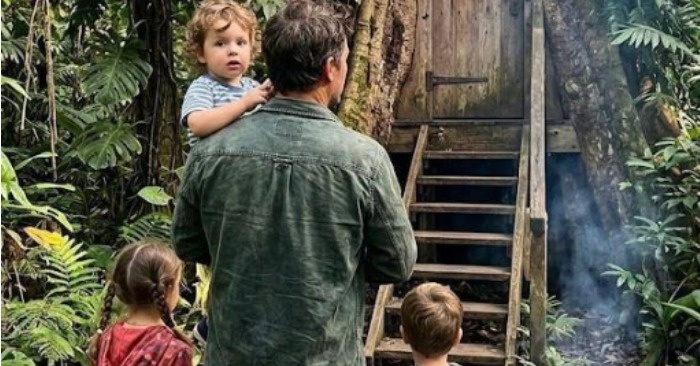
It was Valentina who found the extraordinary. One afternoon, while the twins explored, she called from a clearing: “Dad, come!” Roberto followed her voice and froze. In the middle of ancient oaks stood the largest tree trunk he had ever seen, like the skeleton of a centuries-old tree. It wasn’t ordinary: it had a wooden door, carved windows, and inside, beams formed a second floor. A house… inside a tree.
They pushed the door open, and the creak sounded like an old sigh. Inside left them speechless: polished walls, a spiral staircase, space for a living room and kitchen, natural light streaming through round windows. “It’s like a fairy tale,” Sofía murmured, running her hand over the wood as if touching a miracle. Roberto felt a warmth in his chest—not full joy, but something close to it: a chance.
They found good dishes, dusty books, and a leather folder with documents. Upstairs, in a trunk, there were fine clothes and old photographs. Roberto forced himself not to touch too much. “First, we need to know who this belongs to,” he said, though his eyes couldn’t leave the place.
Doña Esperanza listened and spoke with quiet respect. “Ah, that’s Professor Castillo’s house. He came years ago, bought the land, and built this wonder. He lived there… and his daughter disappeared. She never came back.” Roberto felt the shiver of a half-open door in life.
At the town hall, Doña Leticia, the secretary, found a dusty file: Alejandro Castillo Mendoza, legal owner since 2008. Taxes paid until 2019; nothing since. “He owes about eight thousand five hundred with interest,” she calculated. For Roberto, it was a mountain—but not impossible.
That afternoon, Roberto returned to the tree house with Sofía. Together, they carefully examined the folder: diplomas, academic letters, certificates. The professor had been an archaeologist, a historian—someone important. In his journal, a sentence made their skin crawl: “Everything is safe in this special place. If something happens to me, I hope someone worthy finds this treasure and uses it properly.”
A treasure? Roberto felt both excitement and fear. The children became detectives, searching for signs, hidden doors, markings in the wood. And again, it was Valentina who saw what others didn’t: a large stone near exposed roots that could be moved. Beneath it was an opening leading to an underground chamber.
Roberto went down first with his phone’s flashlight. Inside, they found shelves and cases holding figurines, pottery, carved obsidian, carefully preserved documents. Everything labeled, everything ordered—as if the professor had prepared his life to be found. On a table lay a sealed letter: “For the next guardian.”
That night, Roberto read it with trembling hands. The professor explained the collection was legal, with permits, hidden before he left for medical treatment. “If I don’t return, I want this used for something good. Take care of my tree house. It was my most beloved home.” Roberto cried quietly—not just for the money it could bring, but for the trust of a stranger leaving him a responsibility.
Joaquín listened wide-eyed. “Brother… if this is real, it changes your life.” For the first time in months, Roberto allowed himself to imagine: education for his children, a safe roof, food without counting tortillas. But he also knew hope came with a price: things had to be done right. He consulted a lawyer, Licenciado Raúl Herrera, and an expert in pre-Columbian art, Professor Esteban Morales. The expert, seeing photos, could barely contain himself: “If it’s authentic, it’s worth a fortune. But we must verify on site—and ensure everything is legal.”
Then came the twist: Professor Castillo had died in Guatemala in 2020. And there was a nephew, Mauricio Castillo, a businessman in Mexico City, already claiming the inheritance.
Roberto felt the ground shift beneath him. Not just because of ownership, but because Mauricio was no ordinary man. “He doesn’t have a good reputation,” warned the lawyer. Scandals, accusations, money. Roberto decided to face him. He went to an elegant office in Polanco, feeling small in his simple clothes but strong in what he defended: his children.
Mauricio greeted him with a cold smile. “I know what’s in that house,” he said bluntly. “I’ll give you fifty-five thousand pesos to leave quietly.” Roberto stood, heart burning. “I don’t accept charity for my dignity.” Mauricio narrowed his eyes. “Then I’ll take it through legal means. And I have resources you can’t even imagine.”
The real war began. Private investigators were hired, the area watched, the chamber hunted. There were veiled threats, pressure, even attempts to involve social services against the children. Roberto felt fear, yes—but also a determination he didn’t know he had: that of a cornered father. With help from the community, he moved the most valuable pieces to safety. Doña Esperanza gathered the people. Don Ramiro Herrera, now mayor, said something that stayed with Roberto: “Your fight is our fight. Enough with the exploiters.”
Roberto investigated Mauricio and found other victims. A teacher from Puebla, María Elena Vázquez, told him how she lost her mother’s house through similar schemes. She gave him evidence of tax fraud and irregularities. With the lawyer, Roberto filed complaints and contacted an investigative journalist, Alejandro Ruiz. The story began to grow.
When Ruiz discovered Mauricio had used falsified documents to prove kinship, everything shifted. But cornered, Mauricio didn’t stop. He showed up in the community with men and a fake court order to evict everyone. This time, Roberto didn’t find fear—he found cameras, local radio, and dozens of neighbors surrounding the trucks. With the lawyer and journalist, he presented the evidence. For the first time, Mauricio hesitated. The united community stripped him of control.
The next day, the story exploded across media and social networks. Mauricio tried to twist the narrative, accusing Roberto of theft and claiming the house was a protected ahuehuete tree. Federal agents came, inspected, and seized some immovable items. Roberto felt the world collapse… until he showed the professor’s letter and permits. The agent’s expression changed. “This appears legitimate.” As for the protected tree, they said they would verify records—if the structure predated certain laws, it might be exempt.
Then came the most dangerous warning: Fernando Guerrero, a former employee of Mauricio, called with a trembling voice. “Mauricio plans to burn the tree house to destroy evidence.” Roberto felt a chill deeper than the forest air. If that happened, it wouldn’t just be fraud—it would be violence.
The community prepared. With help from the journalist’s contacts and federal support, hidden cameras were installed and discreet surveillance arranged. Roberto sent his children away with Joaquín for safety, though it broke his heart. That moonless night, the forest was pure shadow. Around midnight, figures appeared with flashlights. Mauricio led them, carrying fuel. Hidden, Roberto heard him say with contempt: “By tomorrow this will be ashes, and the problem solved.”
As Mauricio took out a lighter, the commander gave the signal. Bright lights flooded the clearing like daylight. “Federal police! On the ground!” There were shouts, confusion—but it ended in seconds. The men dropped everything. Mauricio stood frozen. He was arrested for attempted arson and destruction of evidence. The journalist filmed it all. Fernando provided more information: computers with further fraud. It wasn’t an isolated case—it was a network.
The victory wasn’t loud—it was a collective sigh. Doña Esperanza hugged Roberto in tears. “You did it, son. And you did it without selling your soul.”
In the following weeks, legality was confirmed. The collection was legitimate. The tree house predated modern restrictions. Through proper procedures, Roberto paid the back taxes and moved to legally acquire the land. He didn’t become rich overnight—he became, for the first time in a long time, secure.
When his children returned and entered the tree house, Valentina touched the curved wall as if it were a promise. “Is this really our home?” Roberto lifted her. “It’s ours. And no one will take it from us.”
Roberto sold some pieces—but not on the black market or to anonymous collectors. He sold them to legitimate institutions, ensuring preservation, as the professor had wanted. With that money, he paid debts, secured his children’s education, and supported the local school. Sofía discovered a love for archaeology; Carlos learned carpentry and helped improve the house; Diego found purpose in protecting the forest that had saved them. And Valentina grew up free, without the fear of losing everything.
A year later, Roberto received a letter from María Elena: Mauricio had been sentenced and ordered to compensate his victims. “I got my mother’s house back… and my faith in justice,” it read. Roberto read it at the round table of his unlikely home and thought of María. He imagined her laughter among the wooden walls, her hands combing Valentina’s hair, her voice telling stories before bedtime.
That night, he went out to the clearing and looked at the tree house—solid and quiet, like an old heart still beating. He understood something he never had before: sometimes life takes so much from you that you believe nothing is left… until it forces you to go further than you ever thought possible. And if you walk with love, with honesty, and with a community that won’t let you fall, even the forest can open a door for you.
Roberto Mendoza didn’t just find a home. He found a different destiny. He learned that true wealth is not the money that saves you, but the courage that transforms you; it is not the hidden treasure, but the choice to use it rightly; it is not winning a battle, but teaching your children that dignity must be defended—even when your hands tremble.