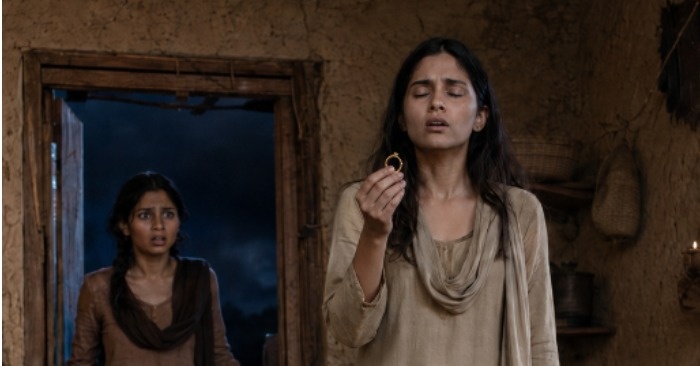
“Give it to me. Father must never find out that you survived this night.”
Saida did not see the knife in her sister’s hand.
But she heard it.
A thin metallic sound, as the blade trembled and scraped against the wooden doorframe.
She stood in the middle of the hut, clutching a gold signet ring in her palm, and for the first time in many years she felt not helplessness.
But truth.
It was close.
In this room.
In her husband’s breathing.
In her sister’s shaking voice.
In the old chest Harun had hidden beneath the mat.
“Amina,” Saida said quietly. “What do you mean, ‘after this night’?”
Her sister did not answer.
She was breathing heavily by the door.
Harun slowly rose from his knees and placed himself between Saida and the entrance.
“Put down the knife.”
Amina laughed nervously.
“You are still pretending to be poor? Even here? Even in front of her?”
Saida turned her head toward her husband.
“You know her?”
Harun remained silent for too long.
And that silence was an answer.
Amina stepped inside.
“He knows all of us. Only you, poor blind Saida, are always the last to learn who is standing beside you.”
Those words would once have hurt her.
Not anymore.
Saida tightened her grip around the ring.
“Then tell me yourself.”
Amina exhaled with anger:
“You were supposed to leave our house quietly. Live with him in filth. Be grateful that Father found you any husband at all. But you ruined everything again.”
“What did I ruin?”
“You found the ring.”
Harun said sharply:
“Amina.”
There was a warning in his voice.
But her sister could no longer stop herself.
“She will find out anyway!” Amina shouted. “She is blind, not deaf!”
Saida stood still.
Her heart was pounding so loudly that it felt as though it would betray her fear before she could ask the next question.
“Is this my mother’s ring?”
Silence.
Then Harun answered:
“Yes.”
Saida’s legs almost gave way.
He managed to catch her, but she pushed his hand away.
“Do not touch me. Speak.”
Harun closed his eyes.
He had been waiting for this moment since the night he took her hand after the wedding and understood that standing before him was not merely a girl her father had thrown out of the house.
She was the key to a truth that had been hidden for twenty years.
“Your mother’s name was not what they told you,” he began.
Saida drew in a sharp breath.
“Her name was Maryam.”
“Yes. But before marriage, she had another name. Leila al-Hamdi.”
Amina cursed under her breath.
Saida did not understand.
“That name means nothing to me.”
“It means a great deal to your father,” Harun said. “And to those who once served in the emir’s old house.”
Saida touched the wall to steady herself.
The words fell one after another, but their meaning had not yet formed into anything whole.
“My mother was an ordinary woman.”
“No,” Harun said. “She was the daughter of a man who owned the lands from the river to the northern gardens. After his death, everything was supposed to pass to her. And then to you.”
Saida felt the ring grow heavier in her hand.
“To me?”
Amina stepped closer.
“Enough!”
Harun turned to her.
“You came here with a knife to keep the silence alive. It is too late now.”
Amina was trembling.
But not only from anger.
From fear.
For the first time, Saida heard it clearly.
Her older sister was not afraid of Harun.
And not of her.
She was afraid because the ring had returned to the hands of the rightful heiress.
“Father said Mother died of illness,” Saida whispered.
Harun lowered his voice:
“Your mother died on the night she planned to leave the house and take you with her.”
Saida did not understand immediately.
The words were too cruel.
“Why?”
“Because she had learned that your father forged documents for her lands. He wanted to transfer everything to your sisters and his partners. But there was one problem.”
“Me.”
Harun said nothing.
Saida gave a bitter smile.
“The blind daughter.”
“The lawful daughter of Leila al-Hamdi,” he corrected her. “The only one born after the marriage contract that protected her mother’s inheritance.”
Amina tightened her grip on the knife.
“She will never be able to prove anything.”
Harun turned toward the chest.
“She will.”
He took from it a child’s bracelet.
Small, silver, with a tiny blue stone.
Saida held out her hand.
Harun placed the bracelet in her palm.
She ran her fingers across the smooth surface.
And suddenly froze.
On the inner side were three small raised dots.
She remembered them.
Not with her eyes.
With her skin.
When she was very little, her mother often let her play with that bracelet. Saida used to trace those dots with her fingers and laugh. Her mother called them “three stars for my girl.”
Saida pressed the bracelet to her chest.
And for the first time in many years, a voice came alive in her memory.
Soft.
Warm.
Scented with jasmine.
“If you become afraid, look for the three stars.”
She began to cry without making a sound.
Amina lowered the knife a little.
For one moment, it was as if a sister awakened inside her.
But fear won again.
“Father will not let you leave with this.”
Harun took a sealed letter from the chest.
“That is why we are not going to him.”
“Where are we going?” Saida asked.
“To the old court by the mosque. Tomorrow, the elders will gather there. Your father himself invited them for Amina’s engagement to the merchant’s son.”
Amina turned pale.
“You would not dare.”
“I would,” Harun said. “He humiliated Saida in front of the entire village. That means the entire village will hear the truth.”
Saida lifted her face.
“No.”
Harun turned to her.
“Saida…”
“I will say it myself.”
He fell silent.
She was shaking, but her voice had become firm.
“All my life, other people have spoken for me. Father decided where I should sit. My sisters decided what I should know. People decided what I was worth. Even you kept silent, thinking you were protecting me.”
Harun lowered his head.
“Forgive me.”
“I do not want to be saved again as if I am not here.”
Those words changed everything.
Even Amina found nothing to say.
They spent the night without sleep.
Amina left before dawn.
But not in victory.
She carried fear away with her.
Harun locked the door and sat by the threshold.
Saida sat beside the chest, running her fingers over her mother’s belongings.
The letter.
The bracelet.
A piece of blue cloth.
The ring.
“Why did you marry me?” she asked closer to morning.
Harun was silent for a long while.
“Because your mother saved my life.”
Saida raised her head.
“You knew her?”
“I was a boy in her father’s house. The son of the estate manager. When the disputes over the lands began, my father was accused of theft and driven out. Your mother gave us money and a letter so we could leave. She said, ‘One day I will need someone who remembers the truth.’”
“And you came back.”
“Yes.”
“As a beggar?”
He smiled bitterly.
“That was safer. A wealthy man would never have been allowed near you. A beggar was someone your father chose himself, because he thought he was humiliating you.”
Saida slowly ran her fingers over his hand.
Now she understood what she had felt from the very first day.
His palms were rough from labor, but his movements were precise and restrained.
There was no poor man’s submissiveness in him.
There was the quiet of someone who knew how to wait.
“You wanted to use me to expose him?”
Harun flinched.
The question was fair.
“At first, I wanted to repay my debt to your mother,” he said honestly. “Then I saw you on the day of the wedding. You stood before everyone alone. They laughed, and you did not cry. And I understood that the truth was not needed by the dead. It was needed by you.”
Saida listened.
Something inside her hurt.
But it was no longer the old pain of humiliation.
It was the pain of choice.
“You should have told me sooner.”
“Yes.”
“I am angry.”
“You have that right.”
She turned slightly away.
“But I will still go with you.”
At dawn, the village woke in noise.
Guests were already gathering at her father’s house. Amina was supposed to receive a wealthy groom, a new dress, gold bracelets, and the blessing of the elders.
Saida’s father wanted everyone to see that his family was prospering after he had rid himself of the “heavy burden.”
He stood in the courtyard dressed in white, smiling at merchants and accepting congratulations.
Then a murmur rose near the gates.
Quiet at first.
Then louder.
People stepped aside.
Saida walked slowly.
In simple dark clothing.
A cane in one hand.
Her mother’s gold signet ring in the other.
Harun walked beside her.
But not as a beggar.
He wore a clean long cloak, and at his belt was the old emblem of the al-Hamdi house, which several elderly men by the gate recognized.
Saida’s father saw them and stopped smiling.
“What are you doing here?” he said.
Saida stopped.
Everything around them grew quiet.
She could hear people breathing.
The rustle of fabric.
Someone whispered her name.
Amina stood at the entrance to the house. She was not crying, but her breathing was uneven.
“I came to take back what belonged to my mother,” Saida said.
Her father laughed.
“The only thing your mother owned was the sickness she left in this house.”
Someone in the crowd gave an awkward chuckle.
Harun stepped forward, but Saida lifted her hand.
He stopped.
She would do this herself.
Today, herself.
“All my life you said I was the family’s shame,” she said. “Because I cannot see faces. But now I think you were afraid I would one day hear the truth in your voice.”
Her father went pale.
“Take her away.”
No one moved.
The mosque elder, gray-haired Sheikh Abdul, stepped out of the crowd.
“Let her speak.”
Her father turned on him sharply:
“This is a family matter.”
“If a daughter was married off in front of the whole village just to get rid of her, then the village may also hear why she has returned.”
Saida turned her head toward the elder’s voice.
“Thank you.”
She held out the ring.
“This is my mother’s ring. It bears the seal of the al-Hamdi house.”
A murmur passed among the old men.
One of them came closer, took the ring, and examined it for a long time.
“This is Leila’s seal,” he said quietly. “I saw it on the marriage contract.”
Saida’s father stepped forward.
“A forgery.”
Harun took out the letter.
“Then perhaps this is a forgery as well?”
The elder took the letter carefully.
The wax on the seal had cracked, but the mark remained.
When he unfolded the sheet, his expression changed.
“This is Leila’s handwriting.”
The crowd buzzed.
Saida stood motionless, but everything inside her trembled.
She could not see faces.
But she could hear a lie collapsing.
The elder began reading aloud.
In the letter, Leila wrote that her husband was forcing her to sign away the lands, that he was threatening witnesses, and that her youngest daughter, Saida, was the only lawful heir to her personal property. She wrote that if anything happened to her, three things had to be found: the signet ring, the bracelet with three stars, and the blue cloth with the bloodstain by the old well.
At those words, Saida’s father swayed.
But something else was even more terrible.
Amina suddenly began to cry.
Not beautifully.
Not quietly.
But like a person who had carried someone else’s secret for far too long.
“Enough,” she whispered. “Enough already.”
Her father spun around.
“Be silent.”
Amina looked at Saida.
And for the first time, there was no contempt in her voice.
“I saw it.”
Saida froze.
“What?”
Amina covered her face with her hands.
“I was nine. I woke up at night. Mother was standing by the door with you in her arms. She wanted to leave. Father grabbed her by the wrist. They argued. Then she fell near the well.”
The crowd gasped.
Her father lunged toward his daughter.
“You do not understand what you are saying!”
Amina screamed:
“I have understood my whole life!”
The silence became sharp.
Even the wind seemed to stop.
“You told me that if I said anything, Saida would be sent far away and I would be married to an old man. You told me Mother was to blame. That she wanted to destroy the family.”
Saida felt the world tilt beneath her feet.
She wanted to hate Amina.
For the mockery.
For the coldness.
For yesterday’s knife.
But now she heard in her sister’s voice not an enemy.
A little girl.
A terrified little girl who had been forced to grow up beside a murderous secret.
Her father stepped back.
“Lies. All lies.”
Harun placed the piece of blue cloth on the ground.
“Then explain this.”
Saida bent down and touched the fabric with her fingers.
Old.
Stiff.
Along the edge was embroidery.
Three small stars.
The same as on the bracelet.
The elder said slowly:
“This is enough to begin an inquiry.”
Her father suddenly changed.
The mask of power disappeared.
Standing before them was no longer the head of a family.
But a cornered man.
“You all want to take my house from me? My lands? My name?” he shouted. “For her? For a blind girl who does not even know what the things she claims look like?”
Saida stepped forward.
And answered calmly:
“I do not need to see gold to know when it has been stolen.”
That sentence moved through the crowd like a blow.
Her father fell silent.
Then the elder ordered people to take him into the house until the judge from the city arrived.
Saida heard someone say her name for the first time not with pity.
But with respect.
That evening, she sat in the courtyard of her mother’s old house.
Not her father’s.
Now she knew the difference.
Harun stood beside her, but he did not sit.
“You can stay here,” he said. “It is your right.”
“And you?”
“I will take the documents back to the court. Then I will leave, if that is what you want.”
Saida turned her face toward him.
“Why did you decide that I want you to leave?”
He answered quietly:
“Because I also hid the truth.”
“Yes.”
He lowered his head.
“I am guilty.”
“Yes.”
She held out her hand.
He placed his fingers into hers.
“But in the house where I was thrown away, you were the first person who spoke to me as if I were whole.”
Harun did not answer.
She heard how difficult it was for him to breathe.
“I do not know what will happen next,” Saida said. “I do not know whether I will be able to forgive quickly. I do not know what we will become to each other after all this.”
“I will wait.”
“Do not wait like a servant of a debt,” she said. “Live beside me as a person.”
He gently tightened his hold on her hand.
“Then I will stay until you yourself tell me to go.”
Months passed.
The inquiry was long.
Saida’s father denied everything, then blamed Harun, then Amina, then the dead Leila, then Saida herself.
But the documents spoke.
Witnesses who had kept silent for years began to remember.
The old gardener confessed that he had seen blood by the well.
A former servant told how part of Leila’s clothing had been burned that night.
The judge from the city restored Saida’s right to her mother’s lands.
Her father was stripped of control over the property and placed in custody until the final ruling.
Amina did not ask forgiveness immediately.
She came to Saida after forty days.
Without jewelry.
Without her proud walk.
“I do not deserve for you to open the door,” she said.
Saida sat by the window, running her fingers over her mother’s bracelet.
“But you came anyway.”
Amina cried.
“I was cruel.”
“Yes.”
“I laughed at you because I was afraid to look at you.”
“Why?”
“Because you were like Mother. Not in face. In silence. I heard her in you.”
Saida was silent for a long time.
Forgiveness did not come at once.
But she did not close the door.
“Sit,” she said. “Tell me about her.”
And Amina spoke.
For the first time, not about death.
About life.
How Leila laughed when she kneaded dough.
How she loved the color blue.
How she sang to Saida when the little girl could not sleep.
How she stroked Amina’s hair and said that envy was hunger of the soul, not strength.
Saida listened to all of it.
Every word was like a returned piece of her mother.
Meanwhile, Harun restored Leila’s old library.
He hired a woman who knew how to copy books in raised letters. For the first time, Saida gained access to her mother’s letters, old prayers, and family records.
One day, he brought her a girl from a poor family.
The girl also had poor sight.
Her mother said shyly:
“We were told Lady Saida helps children like this.”
Saida smiled.
Lady.
The word sounded strange.
She took the girl by the hand and led her toward the garden.
“Tell me what you hear.”
“Water.”
“What else?”
“Birds.”
“And what else?”
The girl listened carefully.
“Leaves.”
Saida nodded.
“Then the world is already speaking to you. Other people are simply too loud to understand it.”
A year later, a school for blind children opened in Leila’s house.
Not out of pity.
Out of respect.
Saida insisted that every child should have not only food and shelter, but also books, music, training in a craft, walks to the river, and conversations about the future.
Because she knew too well: a child may be deprived of sight, but the world must never be allowed to deprive that child of dignity.
Harun remained by her side.
Sometimes they still argued.
Sometimes Saida remembered that he had stayed silent, and the pain returned.
He did not argue.
He did not justify himself.
He simply stayed.
One evening, they sat beside the very well where her mother’s life had ended.
Now jasmine grew around it.
Saida held the gold signet ring in her hands.
“I have thought for a long time about why Mother left so many signs,” she said. “The ring, the bracelet, the cloth, the letter.”
Harun looked at her.
“So that the truth would survive.”
Saida shook her head.
“No. So that one day I would believe not other people’s eyes, but my own hands.”
She put the ring on a chain and tucked it beneath her clothes.
“I do not see the sun, Harun. But now I know when morning comes.”
He asked softly:
“How?”
She smiled.
“People stop whispering behind my back and begin speaking the truth to my face.”
That evening, Harun asked her for the first time not as a protector.
Not as a debtor.
But as a man who loved.
“Saida, will you ever be able to call me your husband not because you were given away, but because you chose me yourself?”
She was silent for a long time.
Then she reached out and found his face.
With her fingers, she touched his forehead, cheekbones, lips, and beard.
She could not see him.
But she knew him.
Knew him better than many people know what they see.
“I have already chosen,” she said. “I only wanted you to understand that now, I am the one who chooses.”
He pressed her hand to his cheek.
No celebration, no wedding, no wealth could have mattered as much as that quiet moment beside the well.
Her father had once given his blind daughter to a beggar, believing he was throwing her out of his life.
But he had failed to understand the most important thing.
He had given her to a man who brought her not gold.
But truth.
Not a palace.
But a voice.
Not sight.
But the right to decide for herself who she would be.
And when Saida entered her mother’s house as its mistress for the first time, people stepped aside not out of pity.
But out of respect.
Because she had not been the blind one.
The blind ones were those who had looked at her for years and failed to see a person.