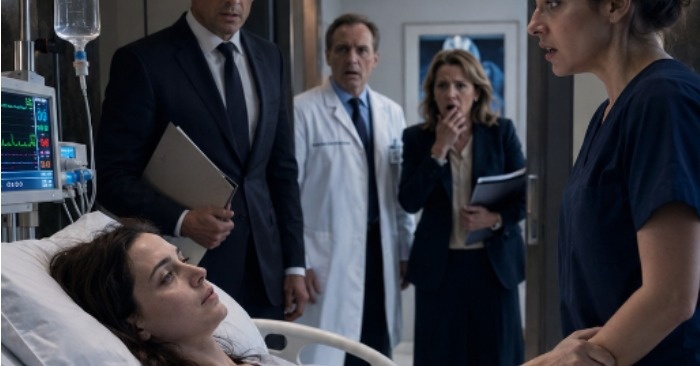
“Now she is waiting for you downstairs.”
The words came from the darkness of the corridor with such calmness that Damian Reyes did not understand their meaning at first.
He was standing in the doorway of the hospital room where his wife had been lying only twenty minutes earlier.
The woman the doctors had almost written off.
The woman over whom he had already leaned and whispered the most foolish confession of his life.
The bed was empty.
The pillow still held the imprint of her head.
The machines continued beeping steadily, as though they had not noticed the patient’s disappearance.
On the white sheet lay a wedding ring.
Beside it was a small voice recorder.
From it, his own voice sounded again:
“Soon, everything will be mine.”
The notary standing behind him slowly pressed the folder of documents to his chest.
“Mr. Reyes… what does this mean?”
Damian turned toward him.
The mask had already returned to his face.
The same one that had made people believe him for years.
“My wife is under the influence of strong medication. Someone is manipulating her.”
He looked at the doctor.
“Find her.”
The doctor turned pale.
“She could not have gone far. In her condition, that is impossible.”
A nurse stepped out of the corridor.
Young. Dark hair pinned at the back of her head. Fear on her face, but firmness in her eyes.
Nora.
She had been on duty beside the room for the past two nights.
Damian looked at her as if he had already sentenced her.
“Where is my wife?”
Nora did not answer immediately.
She looked at the recorder.
Then at the ring.
Then back at him.
“Safe.”
“Do you understand what you have done?”
“It seems that for the first time in a very long while, someone finally did the right thing for her.”
The notary took a step back.
The doctor said in confusion:
“Nora, if the patient left the ward without authorization, that is a violation…”
“She did not leave the ward,” Nora said. “She went down to the first floor. To the main entrance. There are cameras there. People. Police.”
Damian froze for only a fraction of a second.
But Nora saw it.
For the first time since he had entered the hospital room, he was not frightened by his wife’s death.
He was frightened by witnesses.
“Police?” he repeated quietly.
“She asked for them herself.”
At that moment, the recorder clicked again.
And another voice began to play.
A woman’s voice.
Weak, but clear.
“Damian, if you are hearing this recording, it means you came with the documents before you came with remorse.”
He turned sharply toward the device.
The voice belonged to Emilia.
His wife.
“You thought I was dying. Perhaps the doctors thought so too. But I know one thing: the real illness did not begin in my body. It began inside our home.”
Damian stepped toward the bed, but Nora quickly picked up the recorder.
“Don’t.”
He gave a crooked smile.
“Little girl, you have no idea who you have gotten involved with.”
“I do,” she answered. “That is why I recorded everything twice.”
His face darkened.
No loud shout could have been more terrifying than that silence.
Downstairs, in the clinic lobby, Emilia sat in a wheelchair beside the glass wall.
A warm gray blanket was wrapped around her shoulders.
Her face was almost white.
Her lips were dry.
But her eyes were alive.
Beside her stood an elderly clinic security guard and a female police officer.
On Emilia’s lap lay a small velvet box.
The very same one that had once held their wedding rings.
Damian stepped out of the elevator slowly.
He assessed the lobby instantly: cameras under the ceiling, several patients, the receptionist, security, the policewoman, Nora standing slightly behind.
Too many eyes.
That meant he could not shout.
He could not threaten.
He had to play the husband.
He changed his expression before he even reached her.
“Emilia, my love…” he said softly. “You scared me.”
She looked at him without hatred.
And that was worse.
“You scared me too, Damian. Only sooner.”
He crouched in front of her to look caring.
“You should not be getting up. The doctor said…”
“The doctor said I had three days left,” she interrupted. “And you decided that was a convenient deadline for a signature.”
The notary, who had come down after him, looked away.
Damian said quietly:
“You are not yourself.”
Emilia smiled.
“Yes. That is exactly what you were planning to write in the documents.”
She opened the box.
Several items lay inside.
A wedding ring.
A flash drive.
An old photograph.
And a small vial made of dark glass.
When Damian saw the vial, his fingers trembled almost imperceptibly.
Emilia had been waiting for exactly that.
“Recognize it?”
“No.”
“Strange. You brought me drops like these every morning.”
He looked at the doctor.
“It is medicine. Prescribed.”
Nora said quietly:
“Not prescribed.”
Everyone turned toward her.
She took a folded sheet of paper from her pocket.
“I sent a sample to an independent laboratory. Through a pharmacist I know. It contains a substance that, with long-term use, can worsen symptoms of liver failure.”
The doctor went even paler.
“That is impossible. The medication was issued through the clinic’s system.”
Emilia looked at him.
“Not all of it.”
Then she turned her eyes back to her husband.
“Some of it was brought by a loving husband. In a silver spoon. Remember?”
Damian straightened abruptly.
“This is absurd. She is delirious. Do you all hear this? A woman in critical condition is accusing me of poisoning her.”
“No,” Emilia said calmly. “I am accusing you of smiling too early.”
Those words struck more precisely than any piece of evidence.
Because he remembered the hospital room.
Her closed eyelids.
His breath close to her face.
And his own whisper.
Nora placed the recorder on the reception desk and started the next recording.
At first there was the noise of the hospital room.
Then Damian’s voice.
“The apartment, the accounts, the shares… soon, everything will be mine.”
Someone in the lobby gasped softly.
Damian clenched his fists.
“A recording without context proves nothing.”
Emilia nodded.
“Correct. That is why there is more context.”
She took out the old photograph.
In the picture was a young woman with short hair. She was standing beside Emilia near a fountain. Both were smiling.
Damian frowned.
“Who is that?”
“The woman who left me a note beneath the lilies.”
Nora added quietly:
“My older sister.”
The doctor did not understand.
The notary already wanted to leave, but the policewoman stopped him with a gesture.
Emilia lifted the photograph.
“Her name was Leia Moreno. Three years ago, she worked for your charity foundation, Damian. The same foundation through which you beautifully laundered your mercy in front of the public.”
Damian gave a short laugh.
“You have completely lost your mind.”
“Maybe. But Leia lost hers too. Her job. Her reputation. Then her life.”
Nora lowered her eyes.
Now her voice trembled:
“My sister was accused of theft. They said she had diverted money from the foundation. She tried to prove that the documents had been forged. A month later, she was found dead at home. Everyone decided she had not been able to live with the shame.”
Emilia looked at Damian.
“And one week before her death, she came to me.”
Everything around them grew quiet.
Even the receptionist stopped typing.
“She said she had proof. That the signatures had not been forged by the accountant. That the money had gone into the personal accounts of a man everyone considered an exemplary husband and benefactor.”
Damian slowly leaned toward Emilia.
Quietly. Almost tenderly.
“Careful, darling.”
Emilia did not back away.
“I was careful. For far too long.”
She placed her hand on the box.
“After Leia’s death, I hid what she had given me. But I did not dare open a case. I was afraid. For the foundation. For the name. For myself. And then I became ill.”
Nora raised her eyes.
“My sister knew that if anything happened to her, we had to look at the lilies.”
The policewoman asked:
“Why lilies?”
Emilia slowly turned her head toward the vase standing near the reception desk.
White lilies were there too.
Damian had brought them.
“Because he always gave them to women he wanted to get rid of beautifully.”
The doctor whispered:
“My God…”
Damian suddenly laughed.
A short laugh.
An ugly one.
“You are listening to a sick woman and a nurse taking revenge for her sister. Wonderful company.”
“And the notary,” Emilia said.
The notary flinched.
“Me?”
She looked at him calmly.
“You brought documents transferring control of my assets in the event of my incapacity. Say out loud who asked you to prepare them urgently.”
The notary swallowed.
Damian turned toward him.
“Stay silent.”
That was a mistake.
Too sharp.
Too real.
The notary stepped back again.
“Mr. Reyes called me last night. He said Mrs. Emilia was not always conscious, but that the signature was needed immediately. He assured me it was her will.”
The policewoman was writing.
Damian understood that the scene was slipping out of his control.
And then he did what had always worked before.
He became the victim.
“Emilia,” he said with pain in his voice, “after everything I have done for you… you are allowing strangers to destroy our family?”
She looked at him for a long time.
“A family does not begin with poison.”
His face froze.
But she was not finished.
“And it does not end with inheritance.”
Emilia nodded to Nora.
Nora took a phone from her pocket.
“Leia sent me one message before she died, but I found it only recently. The old phone was lying in a box at my mother’s house. There was a video.”
Damian stepped forward sharply.
The security guard blocked his path.
“Move him,” Damian hissed.
The guard did not move.
Nora started the video.
Leia appeared on the screen.
Frightened.
Pale.
She was sitting in a car at night.
“If anyone sees this video, it means I did not manage to hand over the documents in person. Damian Reyes did not just steal money from the foundation. He forced me to sign some of the papers, and then he said he would destroy my family. He has a doctor who prescribes drugs without records. He has done this before. A woman named Isabel…”
The video cut off.
Emilia closed her eyes.
“Isabel was his first wife.”
A murmur passed through the lobby.
Damian turned pale.
For the first time, truly pale.
“She died of heart disease,” he said harshly.
“Yes,” Emilia said. “Very convenient. Quiet. Quick. No autopsy, because the grieving husband insisted.”
The policewoman lifted her head.
“Do you have documents related to that case?”
Emilia pointed to the flash drive.
“Everything Leia managed to gather is there. Accounts, letters, statements, contacts for the doctor. I did not know what to do with it. Not until he brought me lilies.”
Nora pressed her lips together.
“My sister said: if the lilies appear again, it means he has already begun.”
Damian suddenly stopped pretending.
His face became empty.
Cold.
The way Emilia had seen it in the hospital room when he thought she could not hear.
“You will not come out of this the winner,” he said.
Emilia tilted her head slightly.
“I do not want to win. I want to survive.”
The policewoman approached Damian.
“Mr. Reyes, you will have to come with us.”
He sneered.
“On what grounds?”
“On the basis of your wife’s statement, the recording, possible document forgery, and suspicion of intentional harm.”
“Suspicion,” he repeated. “You said it yourself.”
Emilia raised one finger.
“Not only suspicion.”
She looked at the doctor.
“Dr. Linares, yesterday you said my test results had sharply worsened. After that, you personally changed the dosage of my medication. Who asked you not to enter one of the ampoules into my chart?”
The doctor opened his mouth.
Then closed it.
Damian slowly turned his head toward him.
“Doctor?”
The man began to sweat.
“I… I did not know it was dangerous. I was told it was experimental support. Mr. Reyes claimed the drug had been approved by the family consultant.”
The policewoman stepped closer.
Damian understood: the doctor had broken.
And his perfect structure began to collapse, not loudly, but almost soundlessly.
Like glass when the first crack spreads across it.
“You will all regret this,” he said.
Emilia looked at him with tired pity.
“No, Damian. I will be the one who regrets. The years I spent beside a man, mistaking his coldness for strength.”
He was led away through a side corridor.
Without shouting.
Without fighting.
Only once did he turn back.
Not toward his wife.
Toward the box.
The flash drive.
That tiny little vault of truth he had failed to find in time.
When the doors closed, Emilia allowed her shoulders to drop for the first time.
Nora crouched beside her.
“Are you feeling worse?”
“Very,” Emilia said honestly.
“You need to return to the room.”
Emilia looked at the white lilies near the desk.
“Only remove those first.”
Nora took the vase and carried the flowers into the corridor.
A few hours later, Emilia was transferred to another clinic.
Not secretly.
Officially.
Under protection.
With a new doctor.
New tests.
Clean medication.
The first twenty-four hours were hard.
She kept slipping into sleep and then waking in fear that she would see Damian by her bed again.
But Nora was there each time.
Not as a nurse waiting for gratitude.
But as a person who had also come for the truth and found it at far too high a price.
On the third day, the prognosis changed.
Not miraculously.
Not like a fairy tale.
Cautiously.
The doctor said:
“Her condition is still serious. But the deterioration has stopped. If her body responds to treatment, we have a chance.”
Emilia closed her eyes.
A chance.
The word was small.
But after a death sentence, it sounded like an entire lifetime.
Two weeks later, she was able to sit by the window for the first time without machines beside her.
Nora brought her tea.
“Documents arrived from the lawyer.”
Emilia looked at the folder.
“Already?”
“Damian is trying to challenge everything. He says you are incapacitated and the recordings were forged.”
Emilia smiled with one corner of her mouth.
“Of course.”
“Are you afraid?”
She was silent for a long time.
“Yes. But before, I was afraid in silence. Now at least I am afraid out loud.”
The investigation lasted for months.
The foundation was closed for inspection.
The accounts were frozen.
Old cases were reopened.
Isabel’s body was exhumed by court order.
Leia Moreno stopped being “a thief” in newspaper headlines.
Her name was returned to her family.
On the day of the official correction, Nora came to Emilia with a printed article.
She did not cry.
She simply placed the sheet on the table and said:
“Today, my mother opened the curtains for the first time in three years.”
Emilia took her hand.
“I am sorry I stayed silent back then.”
Nora shook her head.
“You were afraid too.”
“That is not an excuse.”
“No. But it is the beginning of the truth.”
Damian never confessed fully.
People like him rarely do that beautifully.
He denied, accused, pressured, tried to buy silence, and called himself the victim of a conspiracy between a sick wife and a vengeful nurse.
But the world he had built on smiles and lilies had already cracked.
Too many people had started speaking.
Too many documents had surfaced.
Too many women had stopped being shadows in his biography.
Emilia returned home only six months later.
Not to the mansion that smelled of expensive perfume and fear.
But to her mother’s old apartment, the one she had once been ashamed to show her husband.
The parquet floor creaked there.
The kitchen faucet leaked.
The windows looked out onto a noisy courtyard.
And for the first time in many years, she slept peacefully.
There were no lilies on the table.
Instead, there was a small pot of rosemary.
Nora came by in the evening with a box.
“This is for you.”
Inside lay the velvet box.
The same one.
But now there was no ring in it.
There was a flash drive, a copy of Leia’s case, a note, and a small new key.
“What is this?” Emilia asked.
“A key to an office.”
“What office?”
Nora grew embarrassed.
“I enrolled in legal courses. I want to help women no one believes. The foundation’s lawyer said they will give us a room. If you agree to become a trustee.”
Emilia looked at her for a long time.
Then she laughed.
Weakly.
Hoarsely.
But for real.
“I have barely learned to walk across the room again.”
“Then we will start with the room,” Nora said.
Emilia looked out the window.
Children were kicking a ball around in the courtyard.
Life had not become perfect.
Her body still hurt.
The trial was still going on.
At night, Damian’s voice sometimes returned:
“Soon, everything will be mine.”
But now another voice sounded after it.
Her own.
“No. Not anymore.”
A year later, Emilia entered the courtroom without a wheelchair.
Slowly.
With a cane.
But on her own.
Damian sat at the defense table.
When he saw her, his face changed.
Not from love.
From rage.
Because she had survived.
And that was the strongest evidence against him.
The judge asked her to speak.
Emilia stood.
The courtroom went quiet.
She did not tell everything from the beginning.
She did not decorate the pain.
She did not ask for pity.
She simply said:
“I used to think betrayal looked like shouting, a door, an affair, or a blow. But sometimes it comes with a bouquet of flowers, sits beside your bed, and speaks softly because it is certain you will no longer answer.”
She looked at Nora.
Then at Leia’s mother, who was sitting in the front row.
“I am answering. For myself. For Leia. For Isabel. For everyone who was forced to look weak so the powerful could remain clean.”
Damian turned away.
But this time, his silence no longer saved anyone.
Later, when the hearing was over, Emilia stepped outside.
A light rain was falling.
Nora opened an umbrella, but Emilia stopped her.
“Don’t.”
She lifted her face toward the sky.
Cold drops fell onto her skin.
Living skin.
And it was beautiful.
“You are cold,” Nora said.
“Yes,” Emilia replied. “And I am happy that I can feel it.”
She took the wedding ring off her finger.
The same one in which a tiny storage device with the recording had once been hidden.
She looked at it one last time.
Then she placed it in Nora’s palm.
“Keep it. Not as a memory of a marriage. As proof that even the smallest object can hold the truth when a person is not yet ready to speak.”
Nora closed her hand around the ring.
“And when they are ready?”
Emilia looked toward the open courthouse doors.
“Then the truth no longer hides inside a ring.”
It walks on its own.
Slowly.
With a cane.
But on its own.
And that day Emilia understood: sometimes a person does not begin to live when doctors return hope to them.
They begin to live when they stop dying for someone else’s benefit.
Her husband had thought three days were the countdown to an inheritance.
But it turned out that three days were enough for the woman he had already buried in his plans to wake up.
To hear.
To remember.
And to make the first move.