I sat in my usual spot at the large city square, playing my flute, when I saw the boy for the first time. My fingers moved automatically across the tiny holes of the instrument while my thoughts drifted far away, just like they often did while I performed.
Fifteen years on the streets teaches you how to escape somewhere else when reality becomes too heavy. For me, music was that escape. It was the only thing that could quiet the constant pain in my back and hips, even if only for a little while. I closed my eyes and let the melody carry me somewhere else.
I used to work in a factory. The job was hard, loud, and physically exhausting, but I liked the feeling of being part of a giant rhythm. Every movement had its own timing, almost like a dance.
Then the pain started.
I was in my mid-forties and at first convinced myself it was simply age catching up to me. But eventually, even the smallest tasks became difficult. That was when I knew I needed to see a doctor.
The doctor studied me for a long time before speaking.
“It’s a chronic condition,” he explained quietly. “And unfortunately, it will continue to worsen over time. Especially with the kind of work you do. Medication may reduce the pain, but we cannot cure it.”
I sat there frozen.
THE NEXT MORNING, I WENT STRAIGHT TO MY BOSS AND DESPERATELY ASKED FOR A DIFFERENT POSITION.
“I could work in quality control,” I told him. “Or inventory. Anything that won’t destroy my back.”
But he shook his head apologetically.
“I’m sorry,” he replied. “You’re a good man, but regulations won’t allow it. Those jobs require certifications. Management would never approve it.”
I held on for as long as I could. But eventually, they declared me unfit for work and let me go.
By then, the men at the factory already knew about my illness and how badly I was struggling. On my final day, they surprised me with a gift I have never forgotten:
a wheelchair.
A small voice suddenly pulled me out of my thoughts.
“MOM, JUST LISTEN! IT SOUNDS SO BEAUTIFUL!”
I opened my eyes.
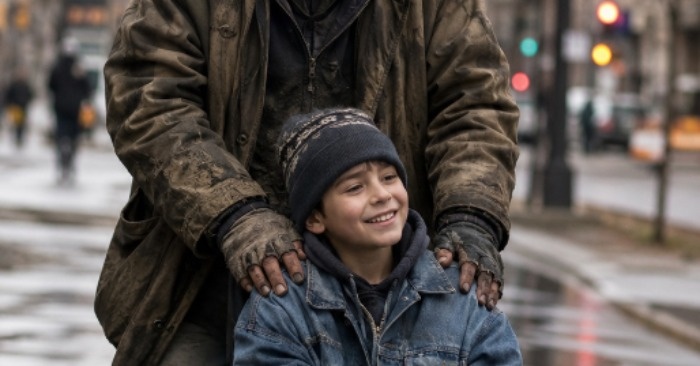
A small crowd had formed in front of me. Among the people stood an exhausted woman carrying a little boy who looked about eight years old.
The child’s eyes glowed with wonder as he watched my fingers moving across the flute. His mother looked drained, worn down by life itself, but when she looked at her son, her expression softened for a moment.
“Can we stay a little longer?” the boy asked, gently tugging at her worn jacket. “Please? I’ve never heard music this beautiful before.”
She adjusted his weight in her arms.
“Just a few minutes, Tommy,” she said softly. “We still have to make it to your appointment.”
“But Mom, look! His fingers move like magic!”
I LOWERED THE FLUTE.
“Would you like to try?” I asked the boy. “I could teach you a simple melody.”
The smile disappeared from his face immediately.
“I can’t walk,” he murmured. “It hurts too much.”
His mother held him a little tighter.
“We can’t afford crutches or a wheelchair,” she explained quietly. “So I carry him everywhere. The doctors say he needs physical therapy, but…”
She never finished the sentence.
In her eyes, I recognized the same desperation I had once seen in my own reflection.
AS I LOOKED AT THE TWO OF THEM, IT FELT LIKE I WAS STARING INTO A MIRROR. THE PAIN. THE EXHAUSTION. THE DAILY STRUGGLE TO HOLD ONTO EVEN A SMALL PIECE OF DIGNITY WHILE LIVING WITH A DISABILITY. AND THAT LOOK PEOPLE GIVE YOU WHEN YOU’RE BOTH SICK AND POOR — THE LOOK THAT PASSES RIGHT THROUGH YOU AS IF YOU’RE ALREADY INVISIBLE.
But in Tommy’s eyes, I saw something I had lost in myself a long time ago:
Hope.
The pure joy on his face as he listened to the music reminded me why I had started playing in the first place.
“How long have you been carrying him around?” I asked carefully, even though I already knew I probably didn’t want to hear the answer.
“For three years,” she replied quietly.
At that moment, I thought about my last day at work. About the men from the factory. About the wheelchair that had changed my life back then.
And suddenly, I knew exactly what I had to do.
BEFORE I COULD CHANGE MY MIND, I GRIPPED THE ARMRESTS OF MY WHEELCHAIR AND PUSHED MYSELF UP. A SHARP PAIN SHOT THROUGH MY BACK AND HIPS, BUT I FORCED MYSELF TO SMILE.
“Take my wheelchair,” I said.
The woman stared at me in shock.
“No… we could never accept that.”
I smiled wider, even though my vision was beginning to blur from the pain.
“I don’t really need it anymore,” I lied. “It’s more like support for me. I’m not truly disabled. But your boy will benefit from it.”
She looked directly into my eyes.
I had the feeling she knew I was lying.
STILL, I SLOWLY PUSHED THE WHEELCHAIR TOWARD THEM.
“Please,” I said softly. “It would make me happy knowing someone who truly needs it is using it. Music isn’t the only gift you can give people.”
Tommy’s eyes widened in disbelief.
“Really? Seriously?”
I nodded, even though the pain was almost taking my breath away.
His mother fought back tears while gently placing Tommy into the wheelchair.
“I don’t even know how to thank you,” she whispered. “We’ve asked for help so many times, but nobody ever wanted to see us.”
“His smile is enough for me,” I said, watching Tommy already testing the wheels with excitement. “Both of your smiles.”
AS THEY WALKED AWAY, MY EYES BURNED WITH TEARS.
I slowly dragged myself toward a nearby bench and collapsed onto it heavily. For the first time, I no longer had to pretend I wasn’t struggling.
That was five years ago.
And time has not been kind to me.
Since then, I’ve had to move around on crutches, and my condition has worsened badly. The pain is constant now. A sharp ache in my back and legs follows me every single day as I leave the damp basement beneath an abandoned building and make my way to the town square.
But I still play the flute.
The music no longer takes the pain away the way it once did, but it keeps me from losing my mind.
I often thought about Tommy and his mother. I hoped my sacrifice had made their lives at least a little easier. Sometimes I imagined Tommy rolling through a park or a school hallway in my old wheelchair while his mother finally walked upright again without carrying the weight of the world on her shoulders.
THEN CAME THE DAY THAT CHANGED EVERYTHING.
I was playing an old folk melody my grandmother had taught me when suddenly a shadow fell across my cup.
I looked up.
Standing in front of me was a well-dressed teenage boy carrying a long package under his arm.
“Hello, sir,” he said with a familiar smile. “Do you remember me?”
I blinked at him in confusion.
Then my heart nearly stopped.
“You?”
TOMMY GRINNED WIDELY.
“I was wondering if you’d recognize me.”
I stared at his legs.
“But… how…? You’re walking!”
He sat down beside me on the bench.
“Life takes strange turns sometimes,” he said. “A few months after you gave me your wheelchair, we found out that a distant relative had left me an inheritance. Suddenly we could afford proper treatment. And it turned out my condition could actually be treated.”
“And your mother?”
Tommy smiled proudly.
“SHE STARTED HER OWN CATERING BUSINESS. SHE ALWAYS LOVED COOKING, BUT BEFORE THIS SHE NEVER HAD THE STRENGTH FOR IT. NOW SHE’S FINALLY LIVING HER DREAM.”
Then he shyly handed me the package.
“This is for you.”
I carefully opened the brown wrapping paper and froze in surprise.
Inside was a beautiful flute case.
“This is only a small attempt to give something back to you,” Tommy said. “You were the only person who helped us when everyone else looked away.”
“I… I don’t know what to say,” I murmured. “This is far too much.”
“No,” Tommy replied gently as he wrapped his arms around me. “I owe my happiness to you. That wheelchair didn’t just help me move around. It gave us hope. It made us believe life could get better.”
TOMMY DIDN’T STAY LONG.
After he left, I slipped the flute case into my old backpack and continued my day like always.
Only later that evening, back in my tiny basement room, did I open the case again with trembling hands.
But there was no flute inside.
Inside were neatly stacked bundles of cash.
More money than I had ever seen in my entire life.
And resting on top was a handwritten note.
“AS THANKS FOR ALL THE PAIN YOU ENDURED BECAUSE OF YOUR KINDNESS. Thank you for showing us that miracles really do exist.”
I SAT THERE MOTIONLESS FOR HOURS, HOLDING THE NOTE IN MY HANDS.
I thought about every painful step I had taken since the day I gave away my wheelchair.
But I also thought about Tommy’s smile.
His mother’s tears.
And how completely their lives had changed.
The money meant more to me than freedom.
It was proof that even the smallest act of kindness can create waves you could never imagine.
“One single act of kindness,” I whispered into the darkness of my tiny basement room as the last bit of light disappeared through the window. “Sometimes that’s all it takes to change everything.”